Nobel Prize in Physics 2026
Neutrinos from deep space
How a cubic kilometre of Antarctic ice became a telescope for neutrinos, and traced them back to distant galaxies.
Laureates: Francis Halzen
Seven pictures.
Text version
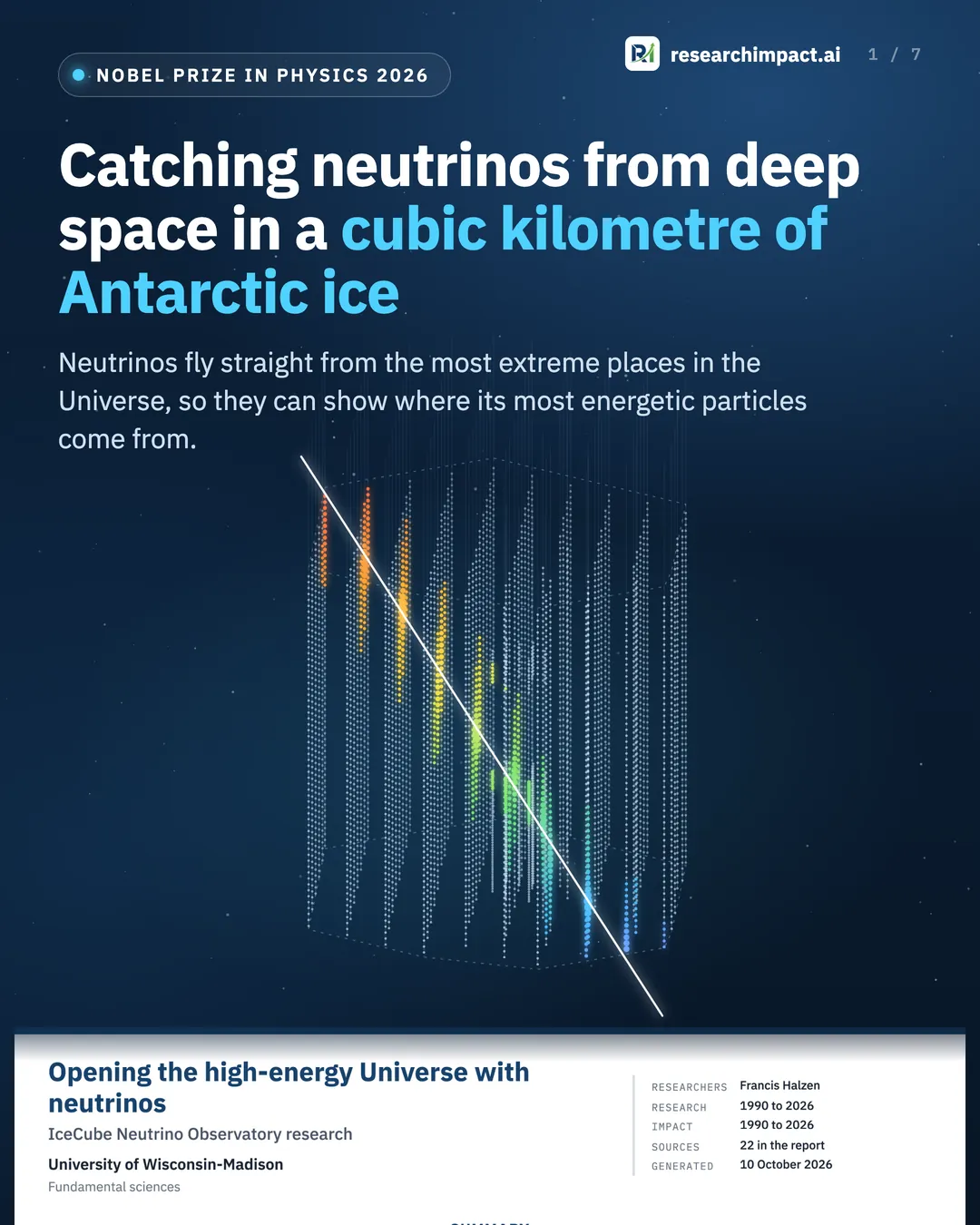
- Catching neutrinos from deep space in a cubic kilometre of Antarctic ice IceCube, a cubic kilometre of Antarctic ice instrumented with 5,160 light sensors on 86 strings, drawn in 3D with a neutrino's track lighting up the sensors. Nobel Prize in Physics 2026, Francis Halzen.
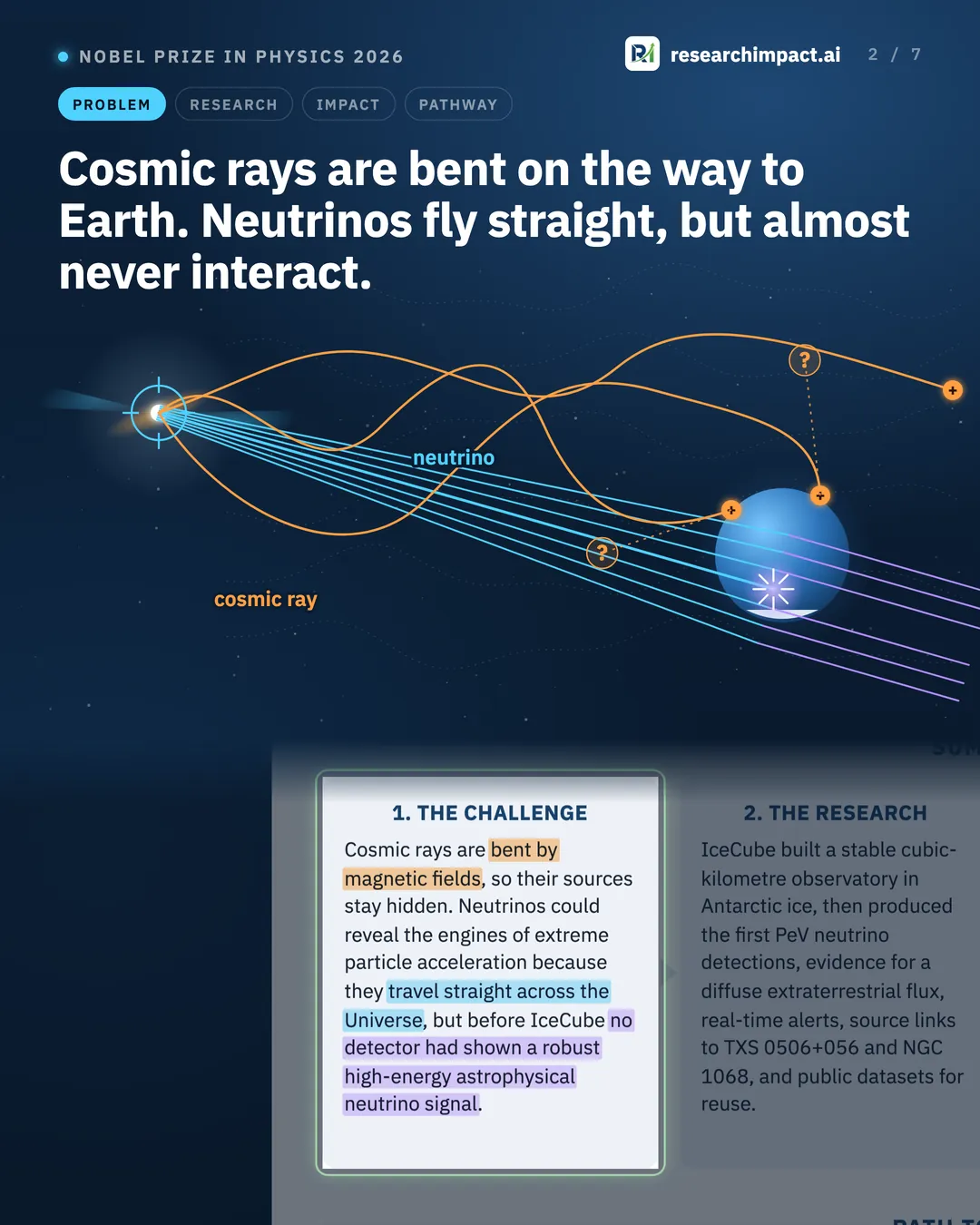
- Cosmic rays are bent on the way to Earth. Neutrinos fly straight, but almost never interact. Cosmic rays, drawn as orange paths, curve away from their source on the way to Earth, while a neutrino travels to Earth in a straight cyan line. Below, the first card of the infographic with these phrases highlighted.
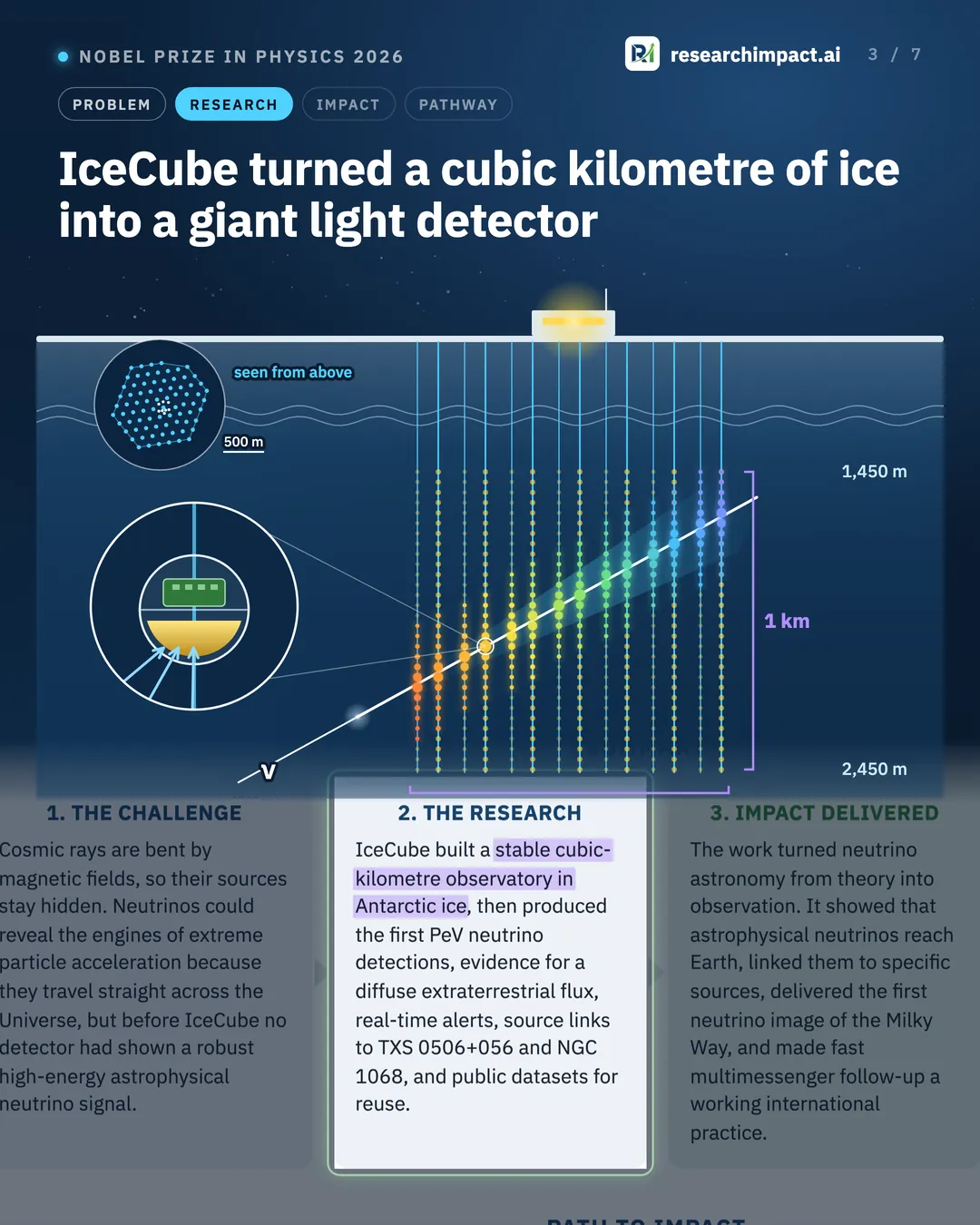
- IceCube turned a cubic kilometre of ice into a giant light detector A cross-section of the ice with the detector's strings between 1,450 and 2,450 metres deep across one kilometre, a magnified light sensor, and a map of the 86 strings seen from above with a 500 metre scale bar.
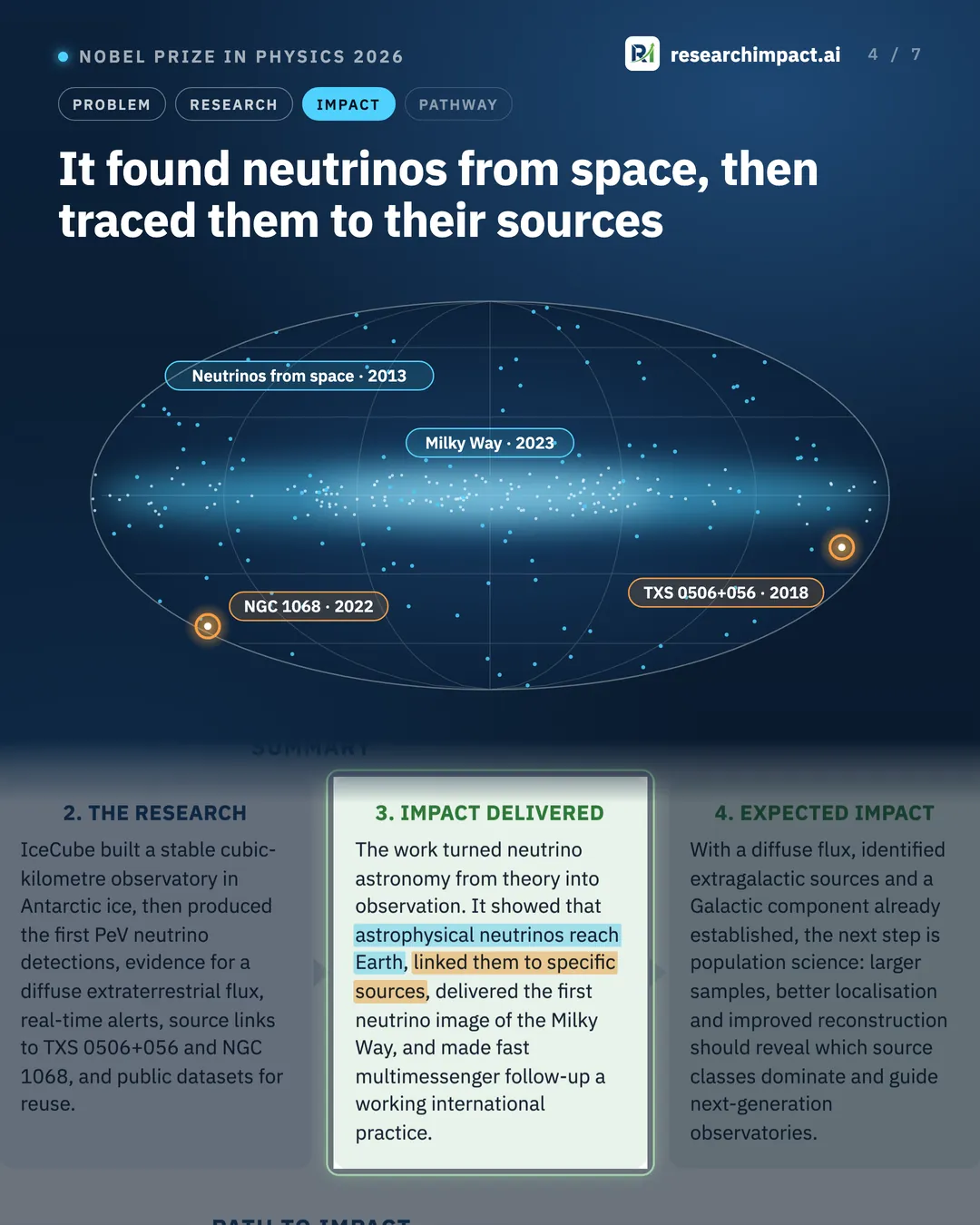
- It found neutrinos from space, then traced them to their sources An all-sky map marking neutrinos from space (2013), the source TXS 0506+056 (2018), the galaxy NGC 1068 (2022) and the Milky Way (2023).
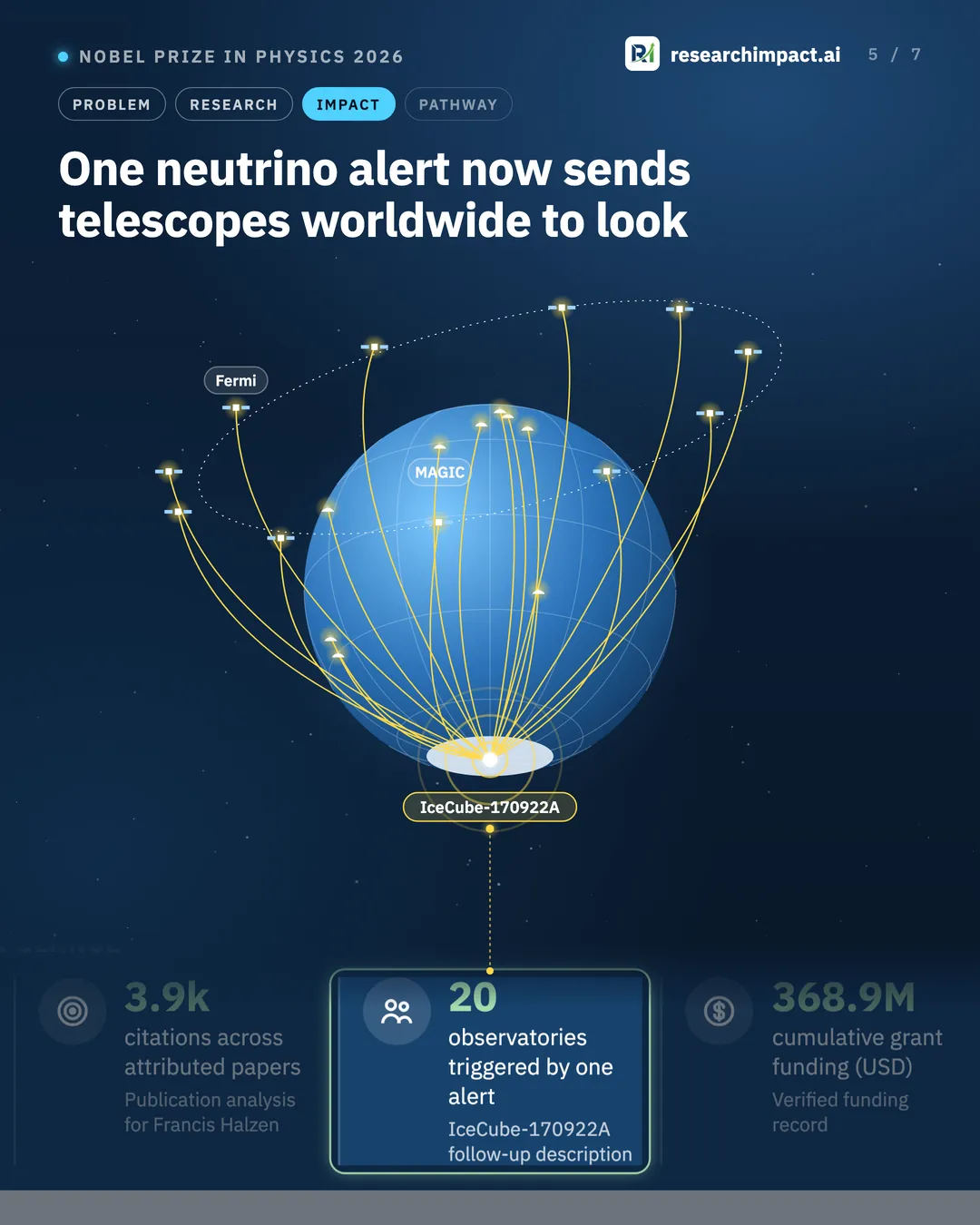
- One neutrino alert now sends telescopes worldwide to look A globe with the IceCube-170922A alert travelling from the South Pole to about 20 observatories worldwide, including the Fermi and MAGIC telescopes.
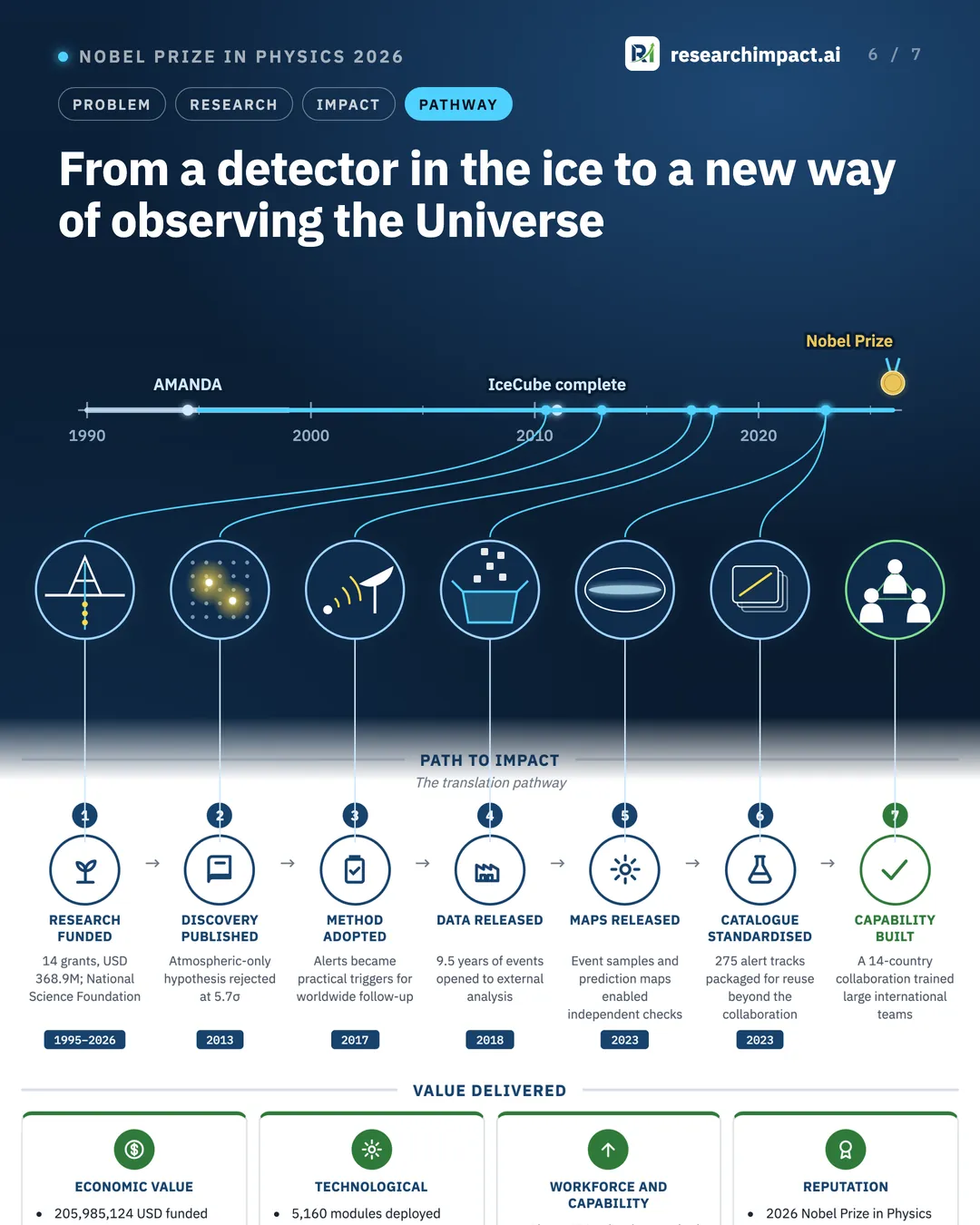
- From a detector in the ice to a new way of observing the Universe A time axis from 1990 to 2026 marking AMANDA in the 1990s, IceCube complete in 2011 and the Nobel Prize in 2026, with each step of the infographic's path to impact illustrated above it.
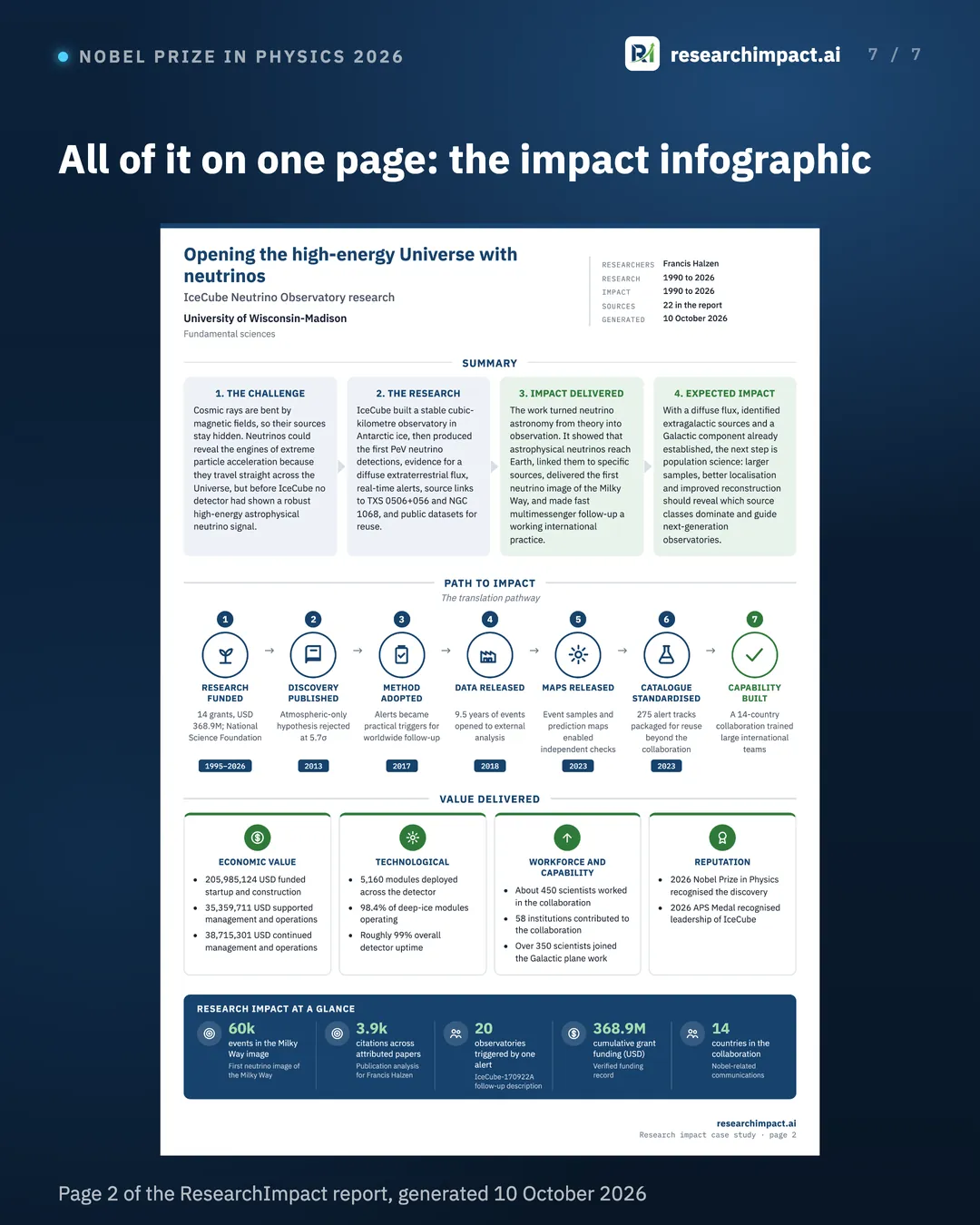
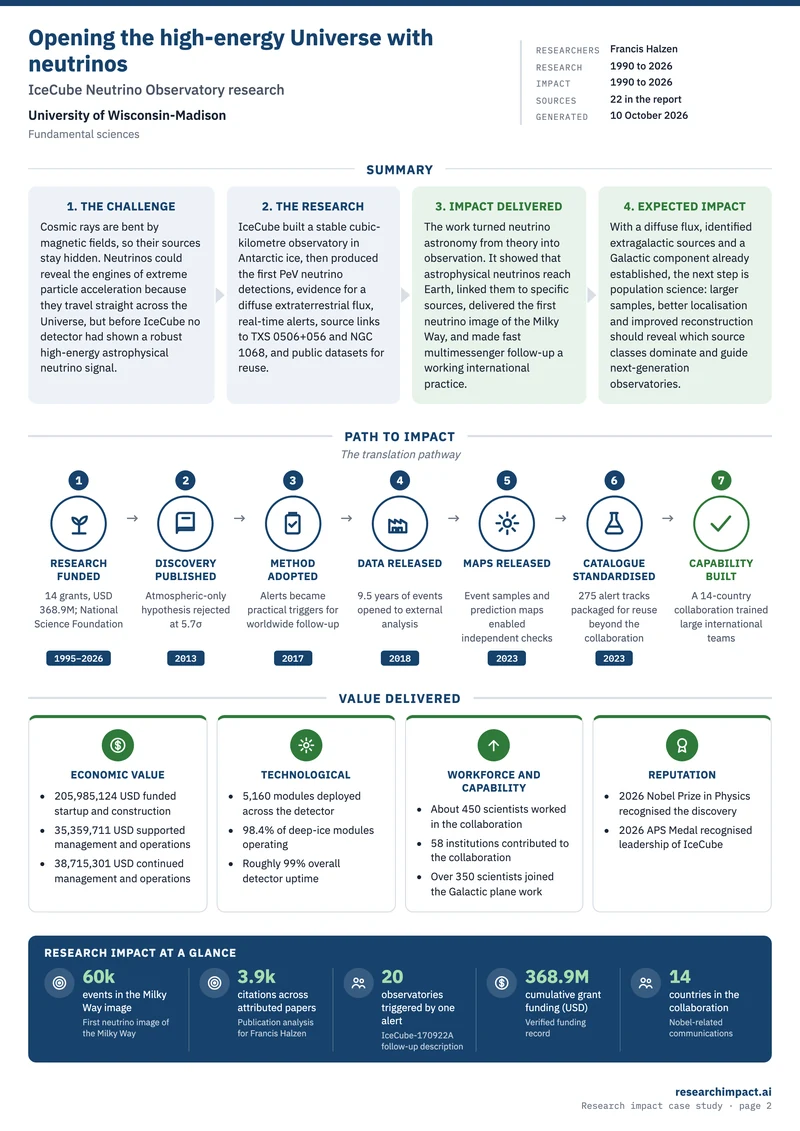
- All of it on one page: the impact infographic The full ResearchImpact infographic for this prize on one page: summary, path to impact, value delivered and research impact at a glance.
The research: a telescope made of ice
The Universe sends particles to Earth with far more energy than any laboratory on the ground can produce. Where they come from is one of the oldest open questions in astrophysics.
Cosmic rays cannot answer it. Because they carry an electric charge, magnetic fields in space bend their paths. By the time they arrive, the direction they come from no longer points back to where they started.
Neutrinos can. They have no charge, so they fly in straight lines from wherever they were made, passing through almost anything along the way. That is also the difficulty: they interact so rarely that catching even a few requires an enormous detector.
Catching the uncatchable
Francis Halzen realised the ice at the South Pole could be that detector. Completed in 2011, IceCube watches a cubic kilometre of Antarctic ice with 5,160 light sensors across 86 strings, frozen at depths between 1,450 and 2,450 metres. On the rare occasions a neutrino hits the ice, it produces charged particles that emit a faint flash of blue light. The sensors record the flash, allowing the team to calculate the neutrino's direction and energy. (In the 1990s, a smaller precursor array called AMANDA had proven that deep ice could work.)
What IceCube found
Then IceCube found what it was built to find:
- 2013: The two most energetic neutrinos recorded at the time, nicknamed "Bert" and "Ernie", were followed by the first evidence of high-energy neutrinos arriving from deep space.
- 2017 to 2018: An alert sent within minutes of a neutrino's arrival prompted about 20 observatories to look. They identified a flaring galaxy, the blazar TXS 0506+056, as the first convincing source of high-energy neutrinos.
- 2022: Evidence revealed neutrinos originating from NGC 1068, a nearby active galaxy.
- 2023: The first portrait of our own galaxy drawn in neutrinos was produced.
The impact reaches far beyond individual discoveries. IceCube turned neutrino astronomy from a theoretical prediction into an active way of observing the Universe. Its alerts changed how observatories collaborate: a single neutrino can now prompt telescopes around the world to aim at the exact same patch of sky. Its data is shared openly, including a public catalogue of 275 alerts from 2011 to 2020, so researchers outside the collaboration can verify and build upon it. Today, about 450 scientists from 58 institutions across 14 countries work on IceCube.
The Nobel Prize in Physics 2026 was awarded to Francis Halzen of the University of Wisconsin–Madison "for decisive contributions to the IceCube Neutrino Observatory and the discovery of high-energy neutrinos of astrophysical origin".
Free to reuse
CC BY 4.0The illustrations, slides, film and infographic are CC BY 4.0. Use and adapt them anywhere; credit ResearchImpact and link to this page.
- Credit line
Illustration: ResearchImpact (researchimpact.ai), CC BY 4.0- Suggested citation
ResearchImpact (2026). Neutrinos from deep space: Nobel Prize in Physics 2026. researchimpact.ai, 12 October 2026. https://researchimpact.ai/explained/2026-nobel-physics-neutrinos. Licensed under CC BY 4.0.
Sources
- The Royal Swedish Academy of Sciences. Press release: the Nobel Prize in Physics 2026. 6 October 2026.
- IceCube Neutrino Observatory. Francis Halzen, IceCube principal investigator, wins 2026 Physics Nobel Prize. October 2026.
- IceCube Neutrino Observatory. How IceCube works.
- IceCube Collaboration. The IceCube Neutrino Observatory: instrumentation and online systems. Journal of Instrumentation, 2017.
- IceCube Collaboration. First observation of PeV-energy neutrinos with IceCube. Physical Review Letters, 2013.
- IceCube Collaboration. Evidence for high-energy extraterrestrial neutrinos at the IceCube detector. Science, 2013.
- IceCube Collaboration and others. Multimessenger observations of a flaring blazar coincident with high-energy neutrino IceCube-170922A. Science, 2018.
- IceCube Collaboration. Neutrino emission from the direction of the blazar TXS 0506+056 prior to the IceCube-170922A alert. Science, 2018.
- IceCube Collaboration. Evidence for neutrino emission from the nearby active galaxy NGC 1068. Science, 2022.
- IceCube Collaboration. Observation of high-energy neutrinos from the Galactic plane. Science, 2023.
- IceCube Collaboration. IceCat-1: the IceCube Event Catalog of Alert Tracks. The Astrophysical Journal Supplement Series, 2023.
- Detector drawing: string and sensor positions from the IceCube-86 geometry table of the open-source GraphNeT project (Apache-2.0). Sky positions of TXS 0506+056 and NGC 1068 from SIMBAD, CDS Strasbourg.
Method
This page starts from a report that ResearchImpact's AI generated on Francis Halzen's work from public sources: publication databases, funder records and the web. The infographic is page 2 of that report. We drew the illustrations from it and checked the facts against the sources above.
The detector is drawn to scale, with all 86 strings at their surveyed positions, and the two galaxies sit at their real places on the sky. The neutrino's track, the bent cosmic rays and the inside of the sensor are illustrations.
This is an independent explainer by ResearchImpact. It is not affiliated with or endorsed by the Nobel Foundation, the Royal Swedish Academy of Sciences, the Nobel Assembly at Karolinska Institutet, or the laureates and their institutions.
Questions or feedback? Write to us at info@researchimpact.ai.