What the 2026 science Nobels teach about impact
This year's Nobel prizes in the sciences all went to work that began decades ago.
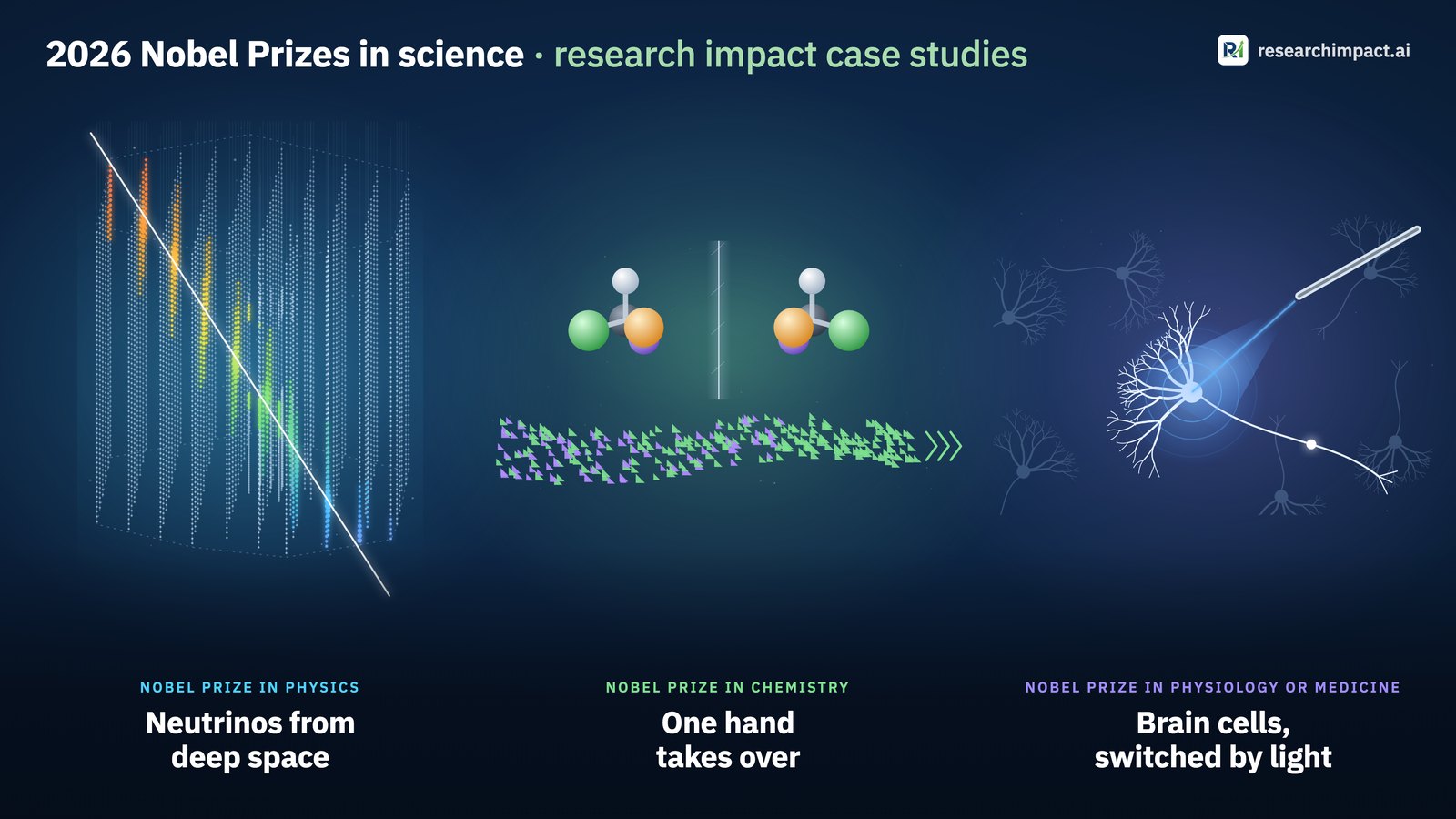
A detector frozen into the Antarctic ice. A reaction in which a molecule copies its own handedness. A protein that helps green algae swim towards light.
None of them looked like impact at the start. Each one changed its field, and one is now being tried in patients.
We told each one in pictures. Each has its own page, free to reuse.
Physics: neutrinos from deep space
Neutrinos fly in straight lines from the most violent places in the Universe, but they almost never interact with anything. Francis Halzen's answer was IceCube: 5,160 light sensors frozen into a cubic kilometre of ice at the South Pole. It found neutrinos from space in 2013, traced one to a flaring galaxy in 2018, and drew the first picture of our own galaxy in neutrinos in 2023.
A personal note
As a graduate student I visited the IceCube labs at DESY in Zeuthen, near Berlin, where they build the spherical light sensors that go into the ice. Standing next to those glass spheres helped push me into research: a year of particle physics at DESY in Hamburg, then astrophysics, then many other fields. DESY is also where I first saw data science and machine learning start to take off. They have been part of much of my research since. I had nothing to do with IceCube's discoveries, but I was very happy to see this prize.
Chemistry: one hand takes over
Life uses only one of the two mirror-image forms of its molecules. Chemistry without life makes both. In 1986 Henri Kagan showed that a catalyst can make a product purer than itself. In 1995 Kenso Soai found a molecule that copies itself and its handedness, turning an excess of 0.00005 per cent into more than 99.5 per cent in three rounds.
Medicine: brain cells, switched by light
Peter Hegemann and Georg Nagel found light-gated channels in green algae in 2002 and 2003. In 2005 Karl Deisseroth's group put one into nerve cells and switched them with light. Optogenetics showed which circuits drive sleep, fear and movement, and in October 2026 a small trial reported improved light sensitivity in people with advanced retinitis pigmentosa.
What they share
Impact takes decades
- 1953: F. C. Frank proposed self-copying molecules. Soai's reaction proved the idea in 1995. The Nobel came in 2026.
- 1990s: AMANDA tested the Antarctic ice. IceCube was completed in 2011, with its first sources identified in 2018 and 2022.
- 2002: Algal channels were discovered. Results from a trial in patients losing their sight were published in 2026.
Many assessment exercises look back about two decades for the research behind an impact. Some of the most important pathways take even longer than that.
Tools are impact
IceCube's alerts, sent within minutes of a neutrino's arrival, now prompt telescopes worldwide to look. Kagan's non-linear plots became a standard method in chemistry. Optogenetic tools have been shared with laboratories globally.
None of these is a finished product or direct patient outcome, but all of them changed how other researchers work. That kind of impact is easy to undersell because it hides inside other people's results.
From algae to patients
Nobody studying how algae swim towards light was trying to restore sight. The route from one to the other ran through ion channels, genetic engineering and mouse neuroscience over more than twenty years.
That route is only visible looking back. It is also why the evidence trail matters: the dates, the papers and the trials, in order.
Open data is impact
IceCube published the data behind its discoveries, along with a catalogue of 275 alerts from 2011 to 2020, so anyone can check and reuse them. Open data lets other people build on the work, and that is often where the next result comes from.
How we made them
Each story starts from a report that our platform, ResearchImpact, generated from public sources in under twenty minutes. We drew the pictures from it and checked the facts against the sources. The infographic at the end is page 2 of that report, as the platform made it.
The pictures, films and infographics are free to reuse under CC BY 4.0, with credit. Questions or feedback? Write to us at info@researchimpact.ai.
Congratulations to all six laureates.
Physics · Chemistry · Medicine
If you need to show the impact of your own research, you can try ResearchImpact free.