Nobel Prize in Physiology or Medicine 2026
Brain cells, switched by light
A light-sensitive protein from green algae became a switch for brain cells, and is now being tried to restore some sight.
Laureates: Karl Deisseroth, Peter Hegemann, Georg Nagel
Seven pictures.
Text version
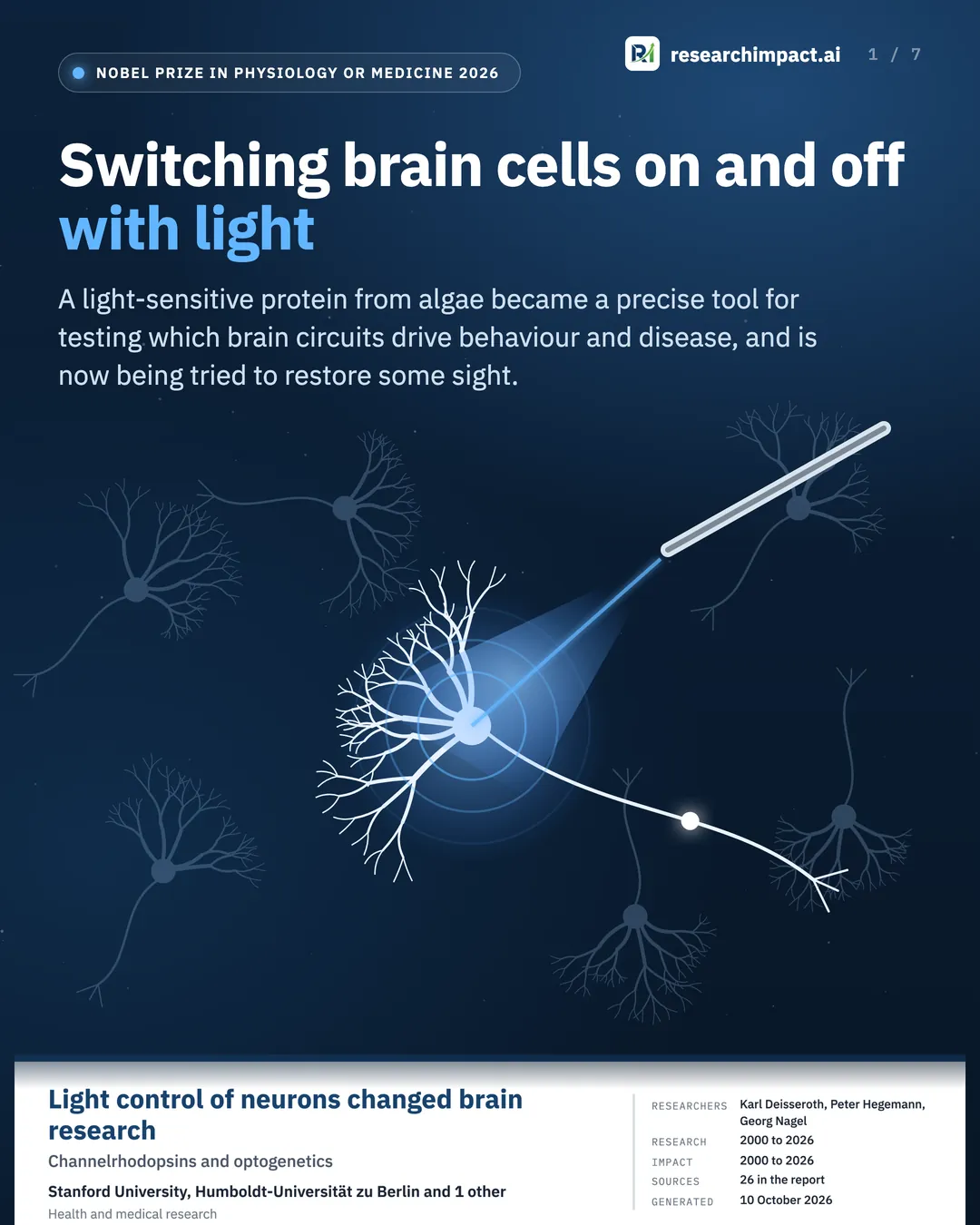
- Switching brain cells on and off with light A nerve cell lit by blue light from a fine optical fibre, firing while the cells around it stay dark. Nobel Prize in Physiology or Medicine 2026, Karl Deisseroth, Peter Hegemann and Georg Nagel.
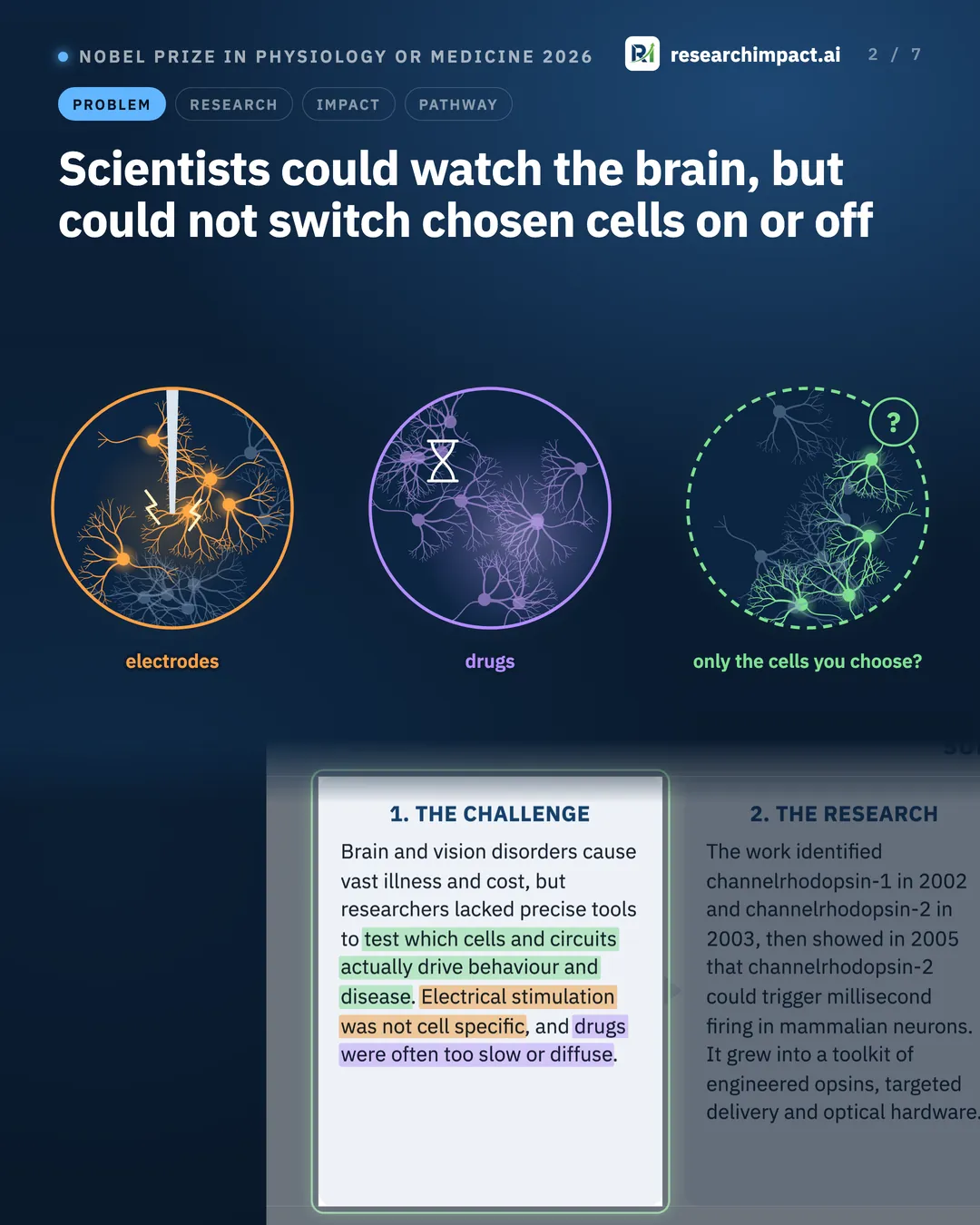
- Scientists could watch the brain, but could not switch chosen cells on or off Three circles of nerve cells: electrodes set off a whole tangle of cells, drugs wash over all of them, and the third asks how to reach only the cells you choose.
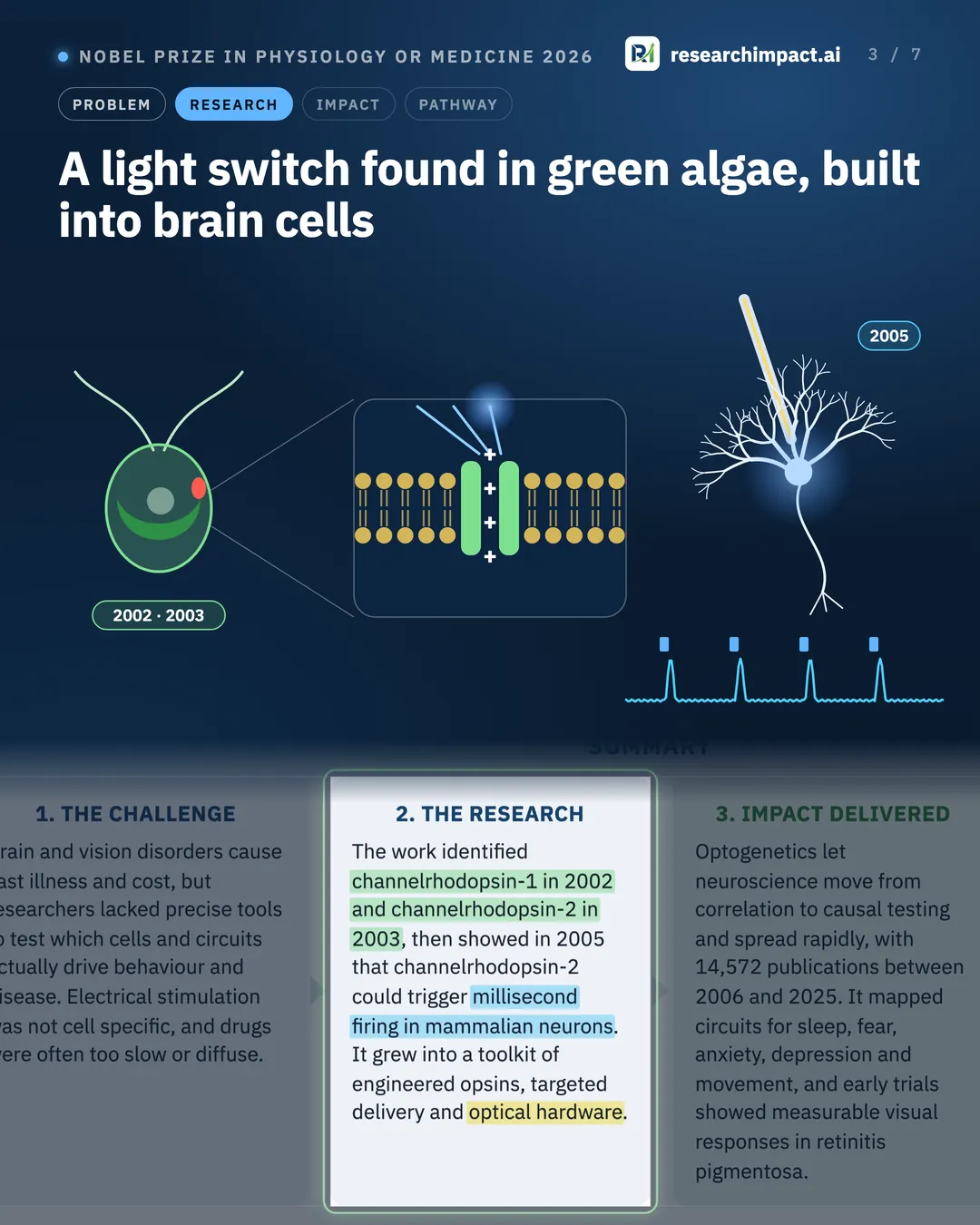
- A light switch found in green algae, built into brain cells A green alga, whose light-gated channels were found in 2002 and 2003, a light-gated channel in a cell membrane, and a neuron switched by a fibre of blue light in 2005, firing in step with flashes of light.
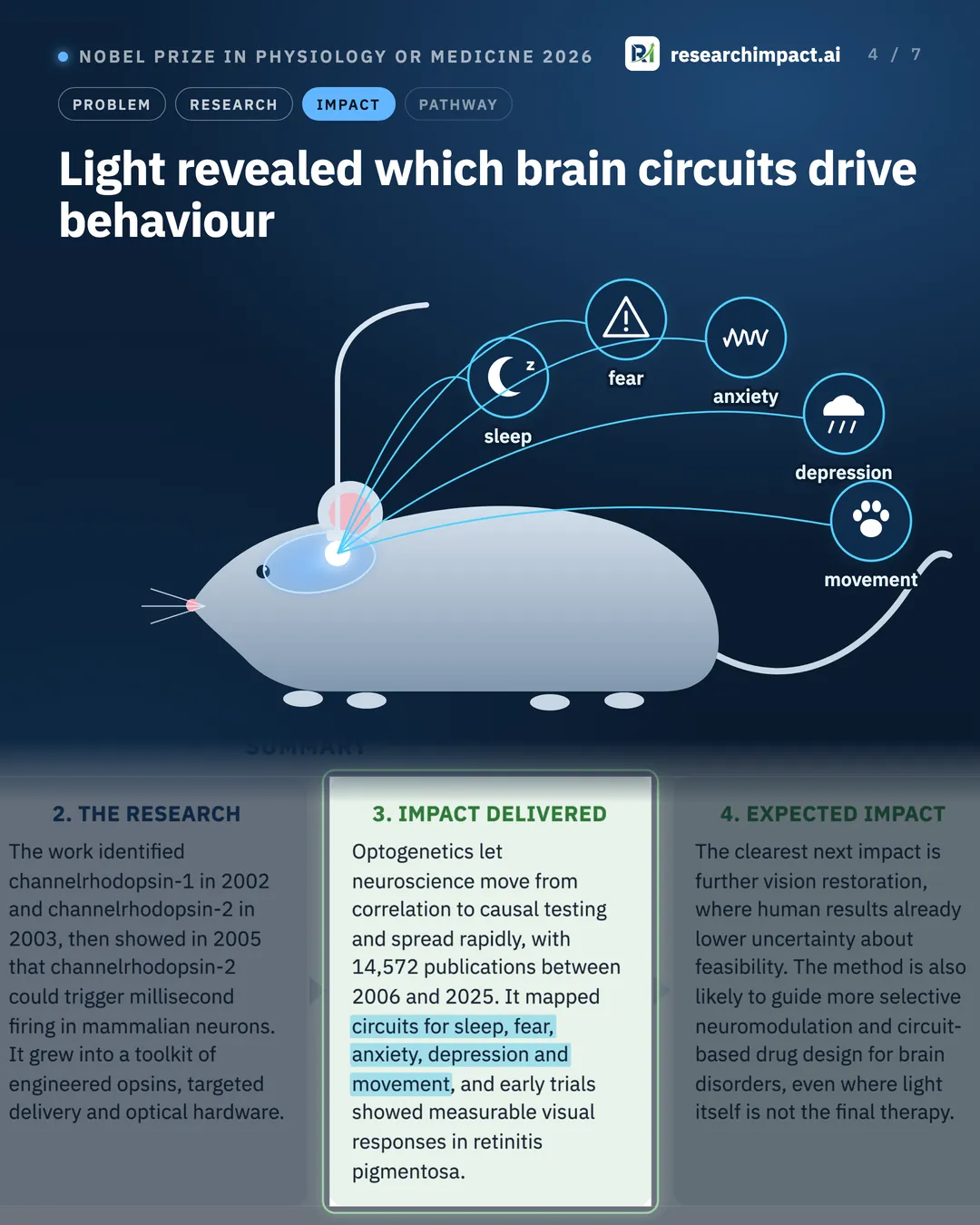
- Light revealed which brain circuits drive behaviour A mouse with lines from its brain to icons for sleep, fear, anxiety, depression and movement.
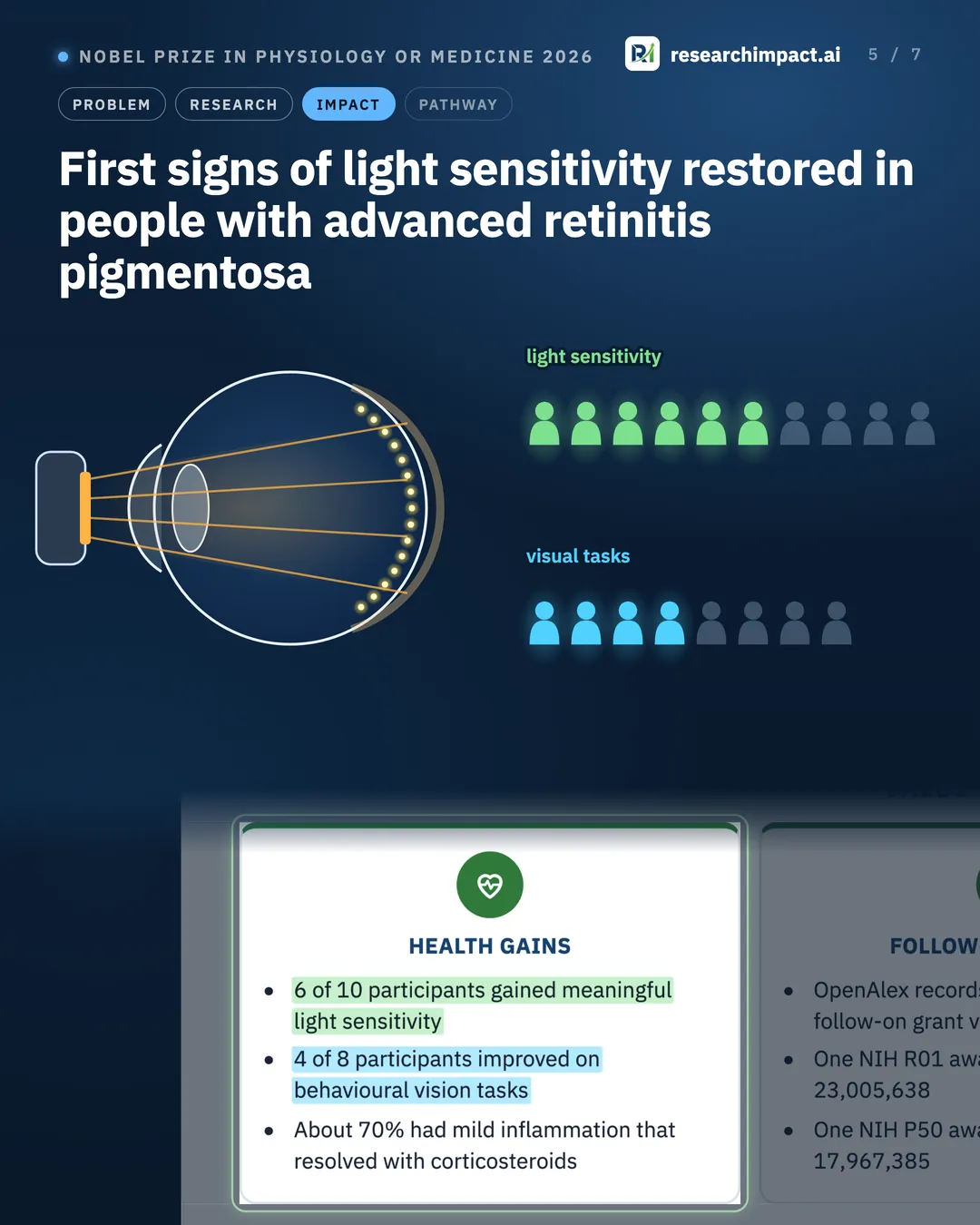
- First signs of light sensitivity restored in people with advanced retinitis pigmentosa Goggles projecting light onto a treated retina, with 6 of 10 figures lit for light sensitivity and 4 of 8 lit for visual tasks.
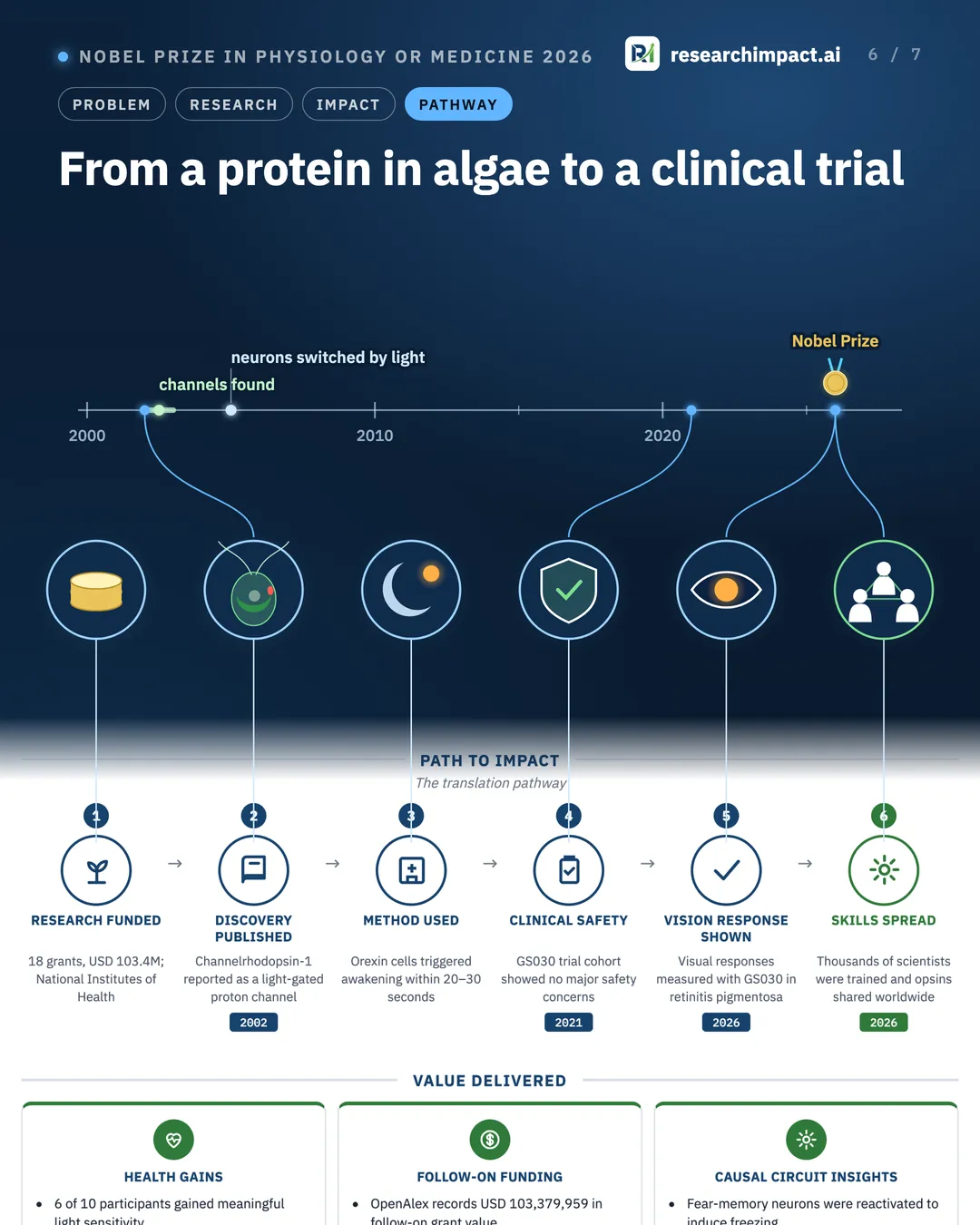
- From a protein in algae to a clinical trial A time axis from 2000 to 2026 marking channels found (2002 to 2003), neurons switched by light (2005) and the Nobel Prize in 2026, with each step of the infographic's path to impact illustrated above it.
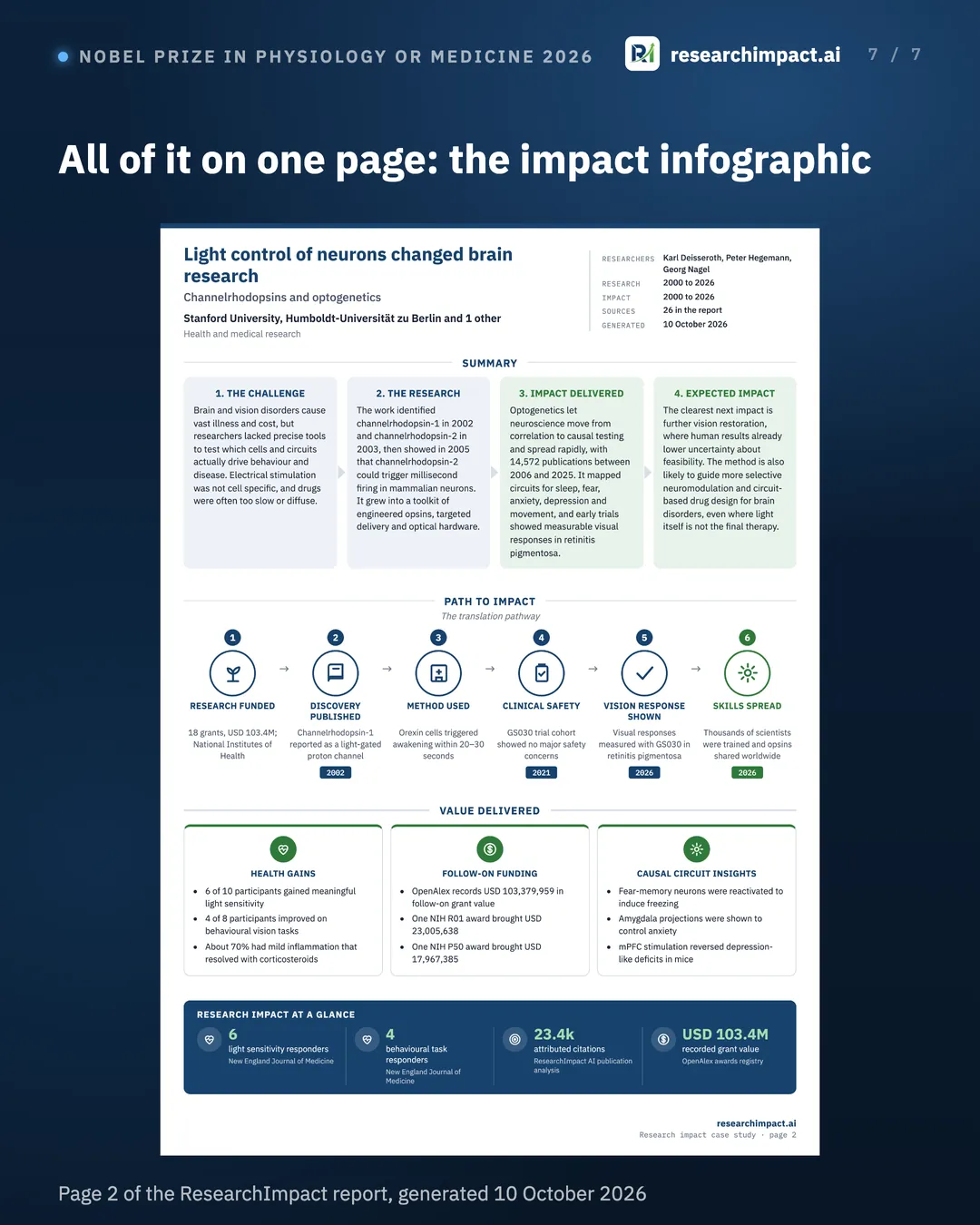
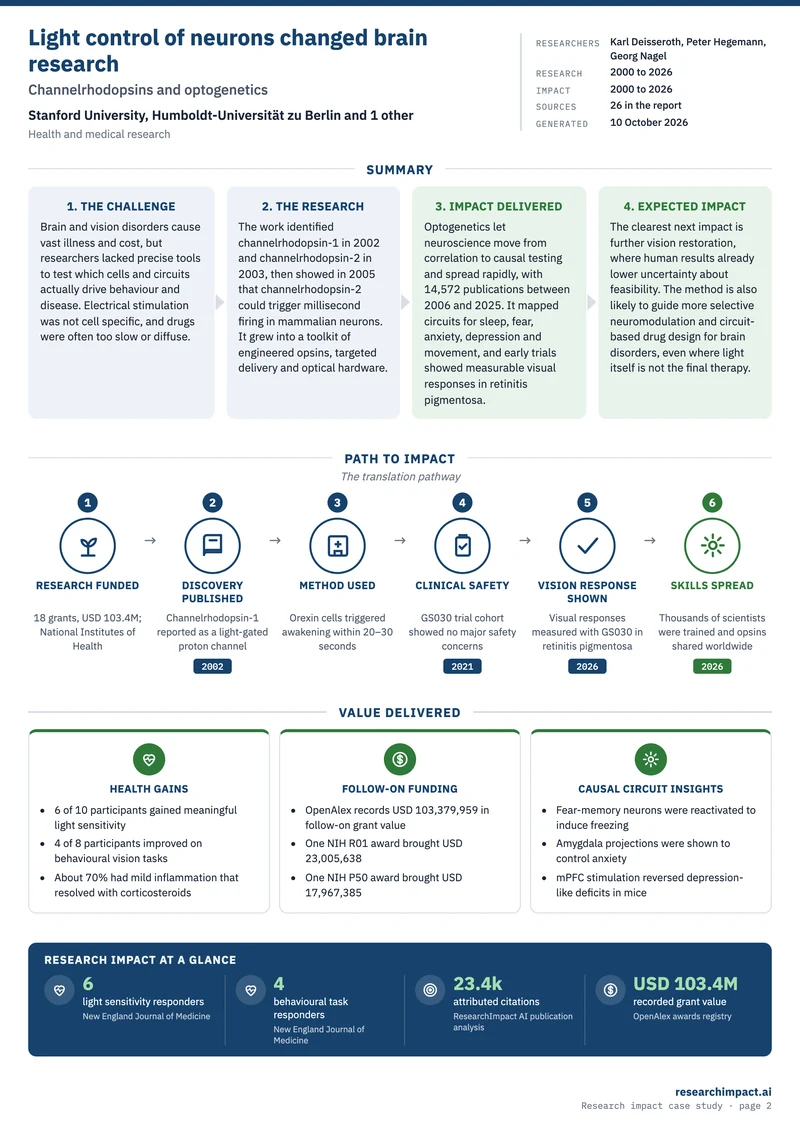
- All of it on one page: the impact infographic The full ResearchImpact infographic for this prize on one page: summary, path to impact, value delivered and research impact at a glance.
The research: optogenetics
Neuroscientists could watch the brain at work long before they could test it. They saw which regions lit up during fear or sleep, but they could not switch a specific cell type on or off to see what changed.
The tools of the time were too blunt: electrodes stimulate every cell around their tip, while drugs act too slowly and spread too widely.
The answer from pond life
Green algae swim towards light, steered by light-sensitive proteins. In 2002 and 2003, Georg Nagel, Peter Hegemann and their colleagues showed that two of these proteins, channelrhodopsin-1 and channelrhodopsin-2, are channels that open when light falls on them. A single protein senses light and simultaneously allows an electric current through the cell membrane.
In 2005, Karl Deisseroth's group introduced channelrhodopsin-2 into mammalian nerve cells. A flash of blue light made the cells fire within milliseconds. By combining genetic targeting, which ensures only chosen cell types produce the protein, with fine optical fibres to deliver light deep into the brain, researchers could control defined cells in a living, moving animal. The method was named optogenetics. Later developments allowed scientists to switch cells off as well as on.
From correlation to cause
In mice, light revealed the neural circuits governing sleep, fear, anxiety, depression and movement. Stimulating one small group of neurons, for example, makes a sleeping mouse more likely to wake within thirty seconds.
Between 2006 and 2025, PubMed listed roughly 14,500 papers mentioning optogenetics. Stanford's training programme has since taught thousands of scientists, and these engineered genes have been shared with laboratories worldwide.
From algae to patients
Results in human trials are now beginning to arrive. Retinitis pigmentosa destroys the light-sensing cells of the eye. In a Phase I/II trial for patients with advanced disease, a gene therapy made surviving retinal cells sensitive to light, paired with goggles that projected light onto the treated eye. Six out of ten participants showed a clinically meaningful improvement in light sensitivity. Among those who completed visual tasks, four out of eight performed better at finding, locating or touching objects while wearing the goggles. The results were published in the New England Journal of Medicine in October 2026. Though this is a small, early trial and the treatment remains unapproved, it marks an important step.
The Nobel Prize in Physiology or Medicine 2026 was awarded jointly to Karl Deisseroth of the Howard Hughes Medical Institute and Stanford University, Peter Hegemann of Humboldt University of Berlin and Georg Nagel of the University of Würzburg, "for their discoveries concerning light-gated ion channels and optogenetics".
Free to reuse
CC BY 4.0The illustrations, slides, film and infographic are CC BY 4.0. Use and adapt them anywhere; credit ResearchImpact and link to this page.
- Credit line
Illustration: ResearchImpact (researchimpact.ai), CC BY 4.0- Suggested citation
ResearchImpact (2026). Brain cells, switched by light: Nobel Prize in Physiology or Medicine 2026. researchimpact.ai, 12 October 2026. https://researchimpact.ai/explained/2026-nobel-medicine-optogenetics. Licensed under CC BY 4.0.
Sources
- The Nobel Assembly at Karolinska Institutet. Press release: the Nobel Prize in Physiology or Medicine 2026. 5 October 2026.
- Naddaf M, Callaway E. Medicine Nobel awarded for brain 'switch' that controls neurons with light. Nature, 2026.
- Stanford Medicine. Karl Deisseroth wins 2026 Nobel Prize in physiology or medicine. October 2026.
- Humboldt-Universität zu Berlin. Nobel Prize for HU neuroscientist Peter Hegemann. October 2026.
- University of Würzburg. Prof. Dr. Georg Nagel, Department of Botany I.
- Nagel G, Ollig D, Fuhrmann M, Kateriya S, Musti AM, Bamberg E, Hegemann P. Channelrhodopsin-1: a light-gated proton channel in green algae. Science, 2002.
- Nagel G, Szellas T, Huhn W, Kateriya S, Adeishvili N, Berthold P, Ollig D, Hegemann P, Bamberg E. Channelrhodopsin-2, a directly light-gated cation-selective membrane channel. PNAS, 2003.
- Boyden ES, Zhang F, Bamberg E, Nagel G, Deisseroth K. Millisecond-timescale, genetically targeted optical control of neural activity. Nature Neuroscience, 2005.
- Touriño C, Eban-Rothschild A, de Lecea L. Optogenetics in psychiatric diseases. Current Opinion in Neurobiology, 2013.
- GenSight Biologics and the 15-20 National Hospital. Announcement of the New England Journal of Medicine publication of the GS030 Phase 1/2 trial results in late-stage retinitis pigmentosa. 8 October 2026.
- PubMed search for "optogenetic*" by publication year, 2006 to 2025, run on 10 October 2026.
Method
This page starts from a report that ResearchImpact's AI generated on the work of Karl Deisseroth, Peter Hegemann and Georg Nagel from public sources: publication databases, funder records and the web. The infographic is page 2 of that report. We drew the illustrations from it and checked the facts against the sources above.
The PubMed count is our own search; the infographic's 14,572 comes from a secondary source. The trial figures are the trial's own. The neurons, the channel, the firing trace and the mouse are illustrations.
This is an independent explainer by ResearchImpact. It is not affiliated with or endorsed by the Nobel Foundation, the Royal Swedish Academy of Sciences, the Nobel Assembly at Karolinska Institutet, or the laureates and their institutions.
Questions or feedback? Write to us at info@researchimpact.ai.