Nobel Prize in Chemistry 2026
One hand takes over
Life uses only one of the two mirror-image forms of its molecules. Kagan and Soai showed how a tiny excess of one form can grow until it wins.
Laureates: Henri B. Kagan, Kenso Soai
Seven pictures.
Text version
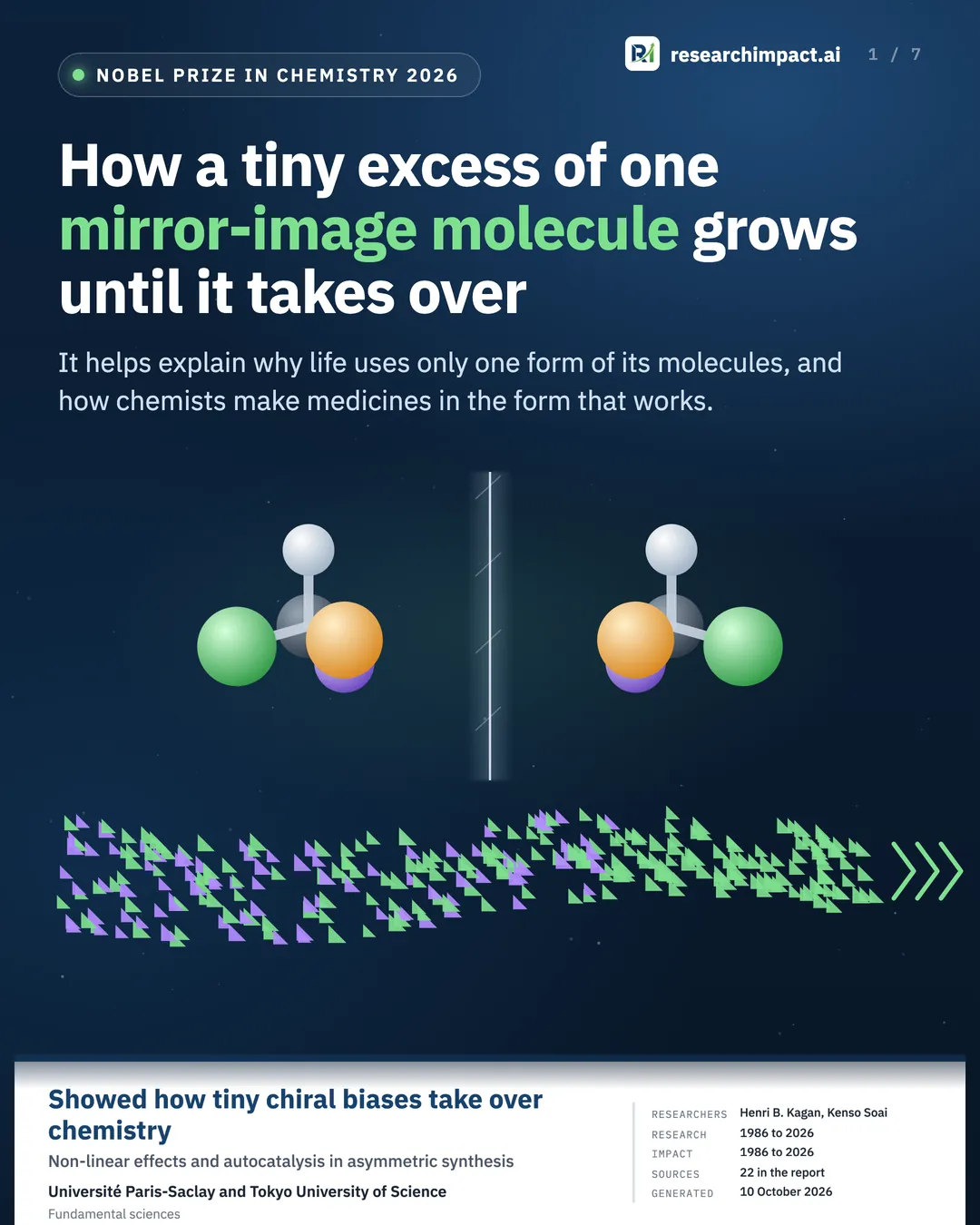
- How a tiny excess of one mirror-image molecule grows until it takes over A molecule and its mirror image either side of a mirror, above a stream of molecules that starts as an even mix of both forms and ends as one form only. Nobel Prize in Chemistry 2026, Henri B. Kagan and Kenso Soai.
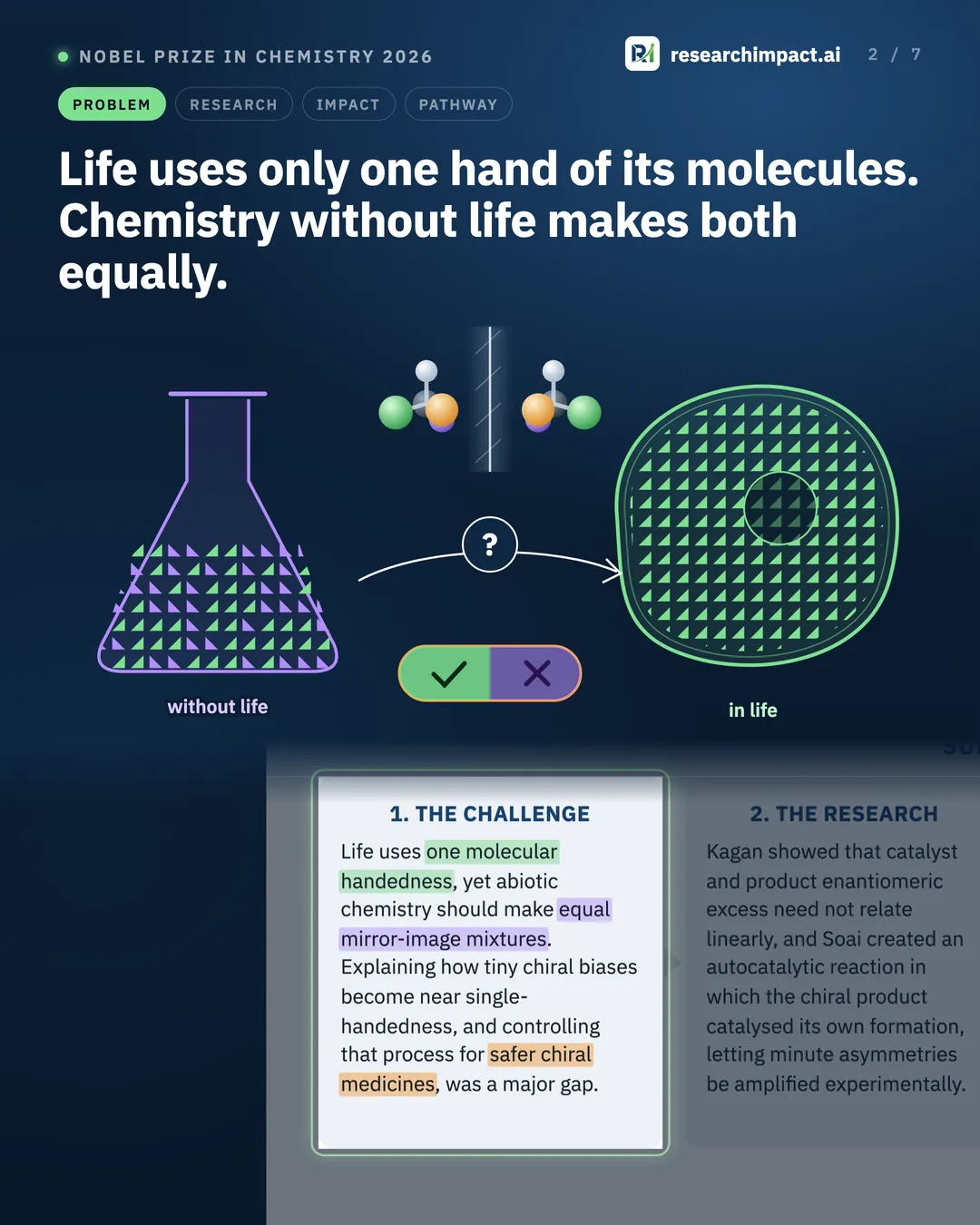
- Life uses only one hand of its molecules. Chemistry without life makes both equally. A flask made without life holding equal numbers of both mirror-image forms, beside a cell in which every molecule has the same hand, and a pill with one form ticked and the other crossed.
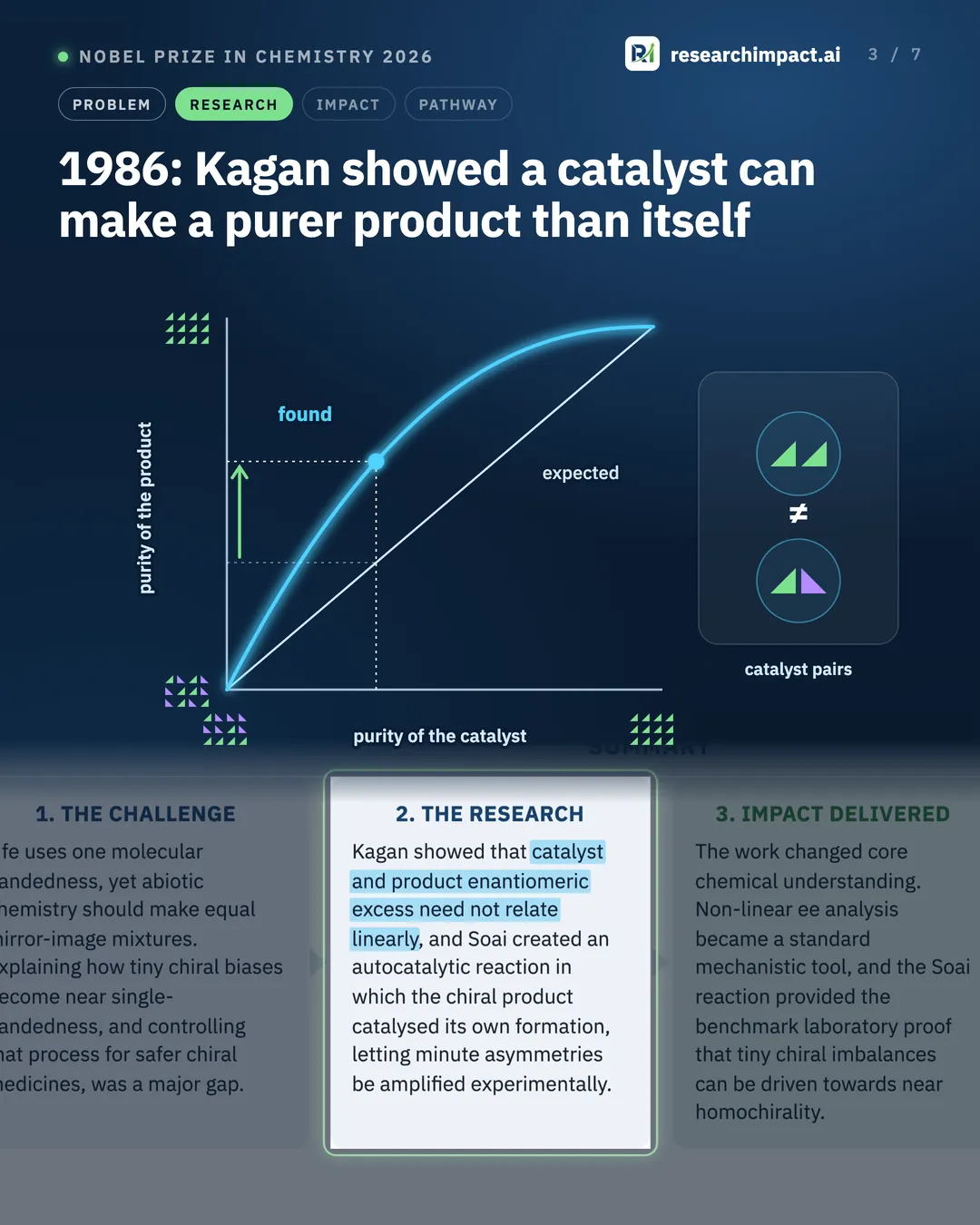
- 1986: Kagan showed a catalyst can make a purer product than itself A graph of product purity against catalyst purity: the expected straight line, and the curve that was found rising above it, with catalyst pairs shown alongside.
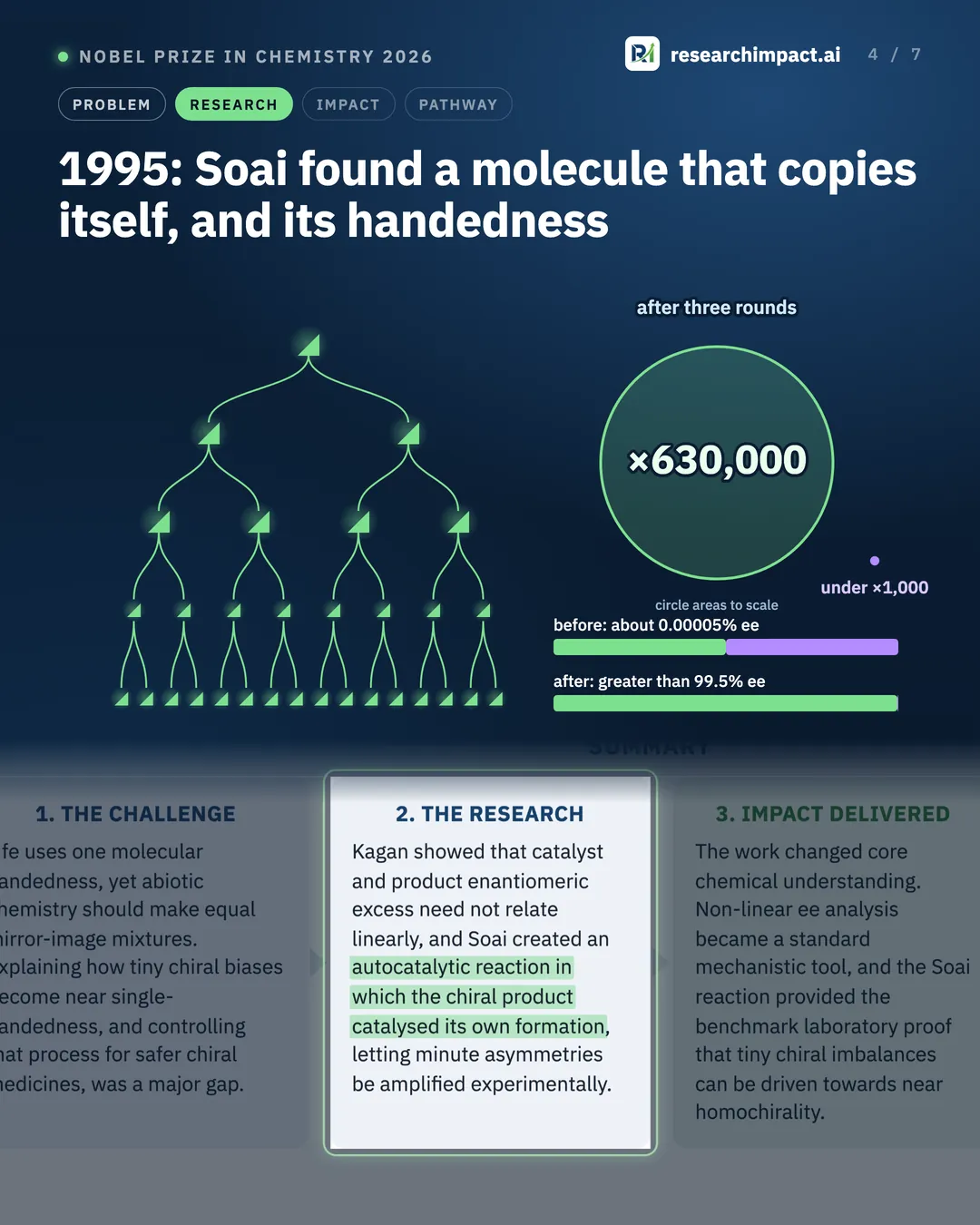
- 1995: Soai found a molecule that copies itself, and its handedness A cascade of molecules copying themselves over three rounds, and two circles with areas to scale: the major form multiplied 630,000 times and the minor form under 1,000 times. Purity bars go from about 0.00005% to greater than 99.5% enantiomeric excess.
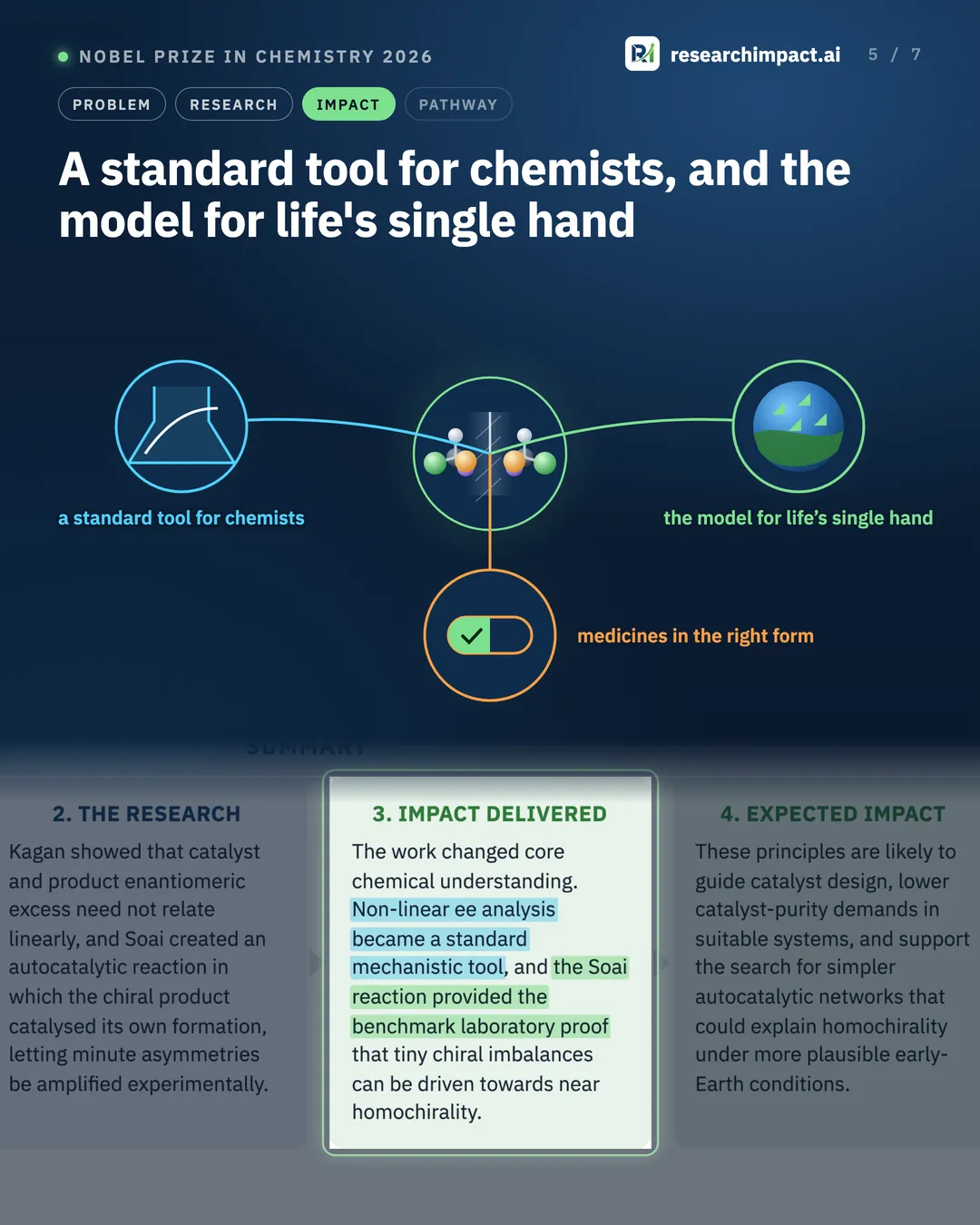
- A standard tool for chemists, and the model for life's single hand Three linked icons: a standard tool for chemists, the model for life's single hand, and medicines in the right form.
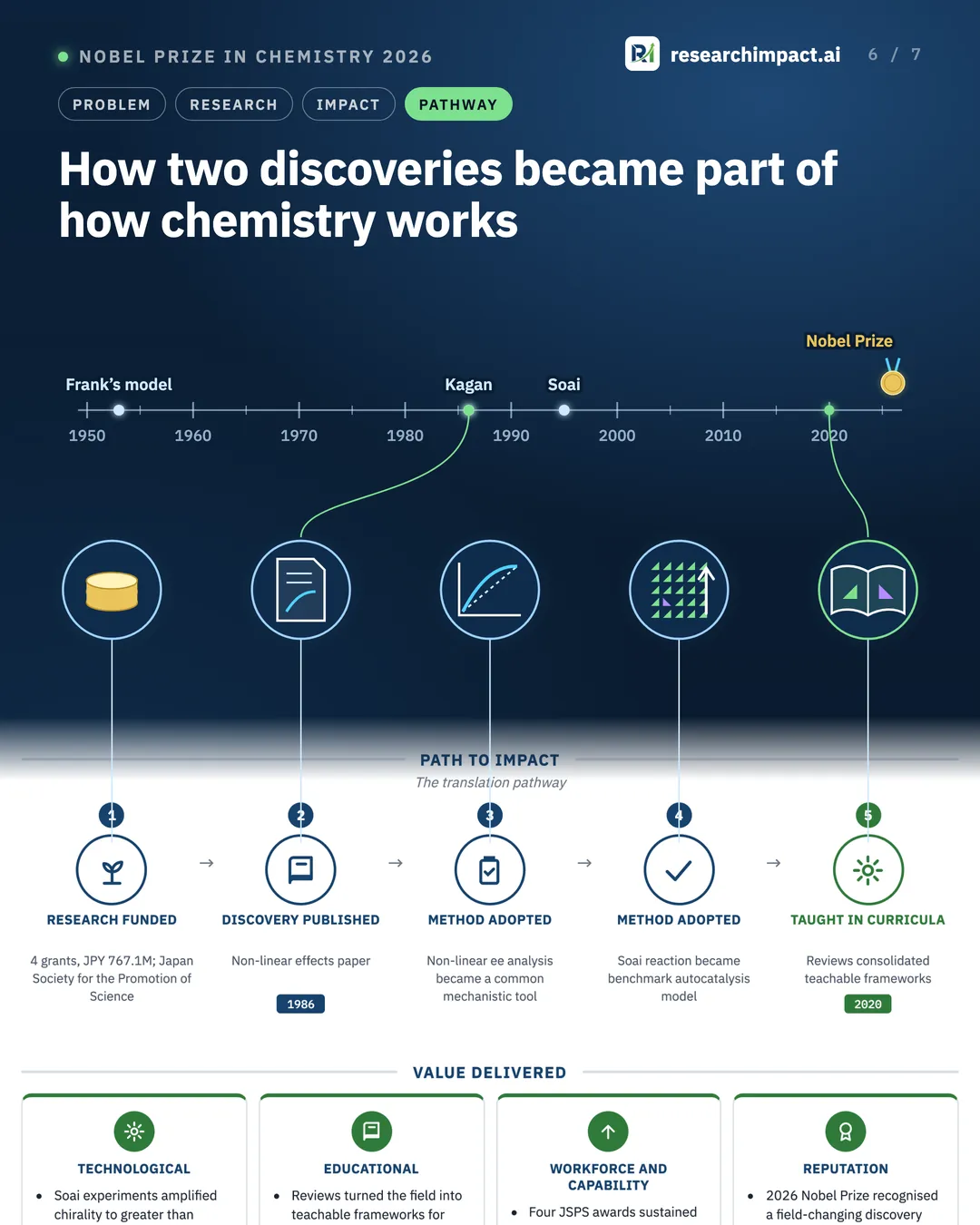
- How two discoveries became part of how chemistry works A time axis from 1950 to 2026 marking Frank's model in 1953, Kagan in 1986, Soai in 1995 and the Nobel Prize in 2026, with each step of the infographic's path to impact illustrated above it.
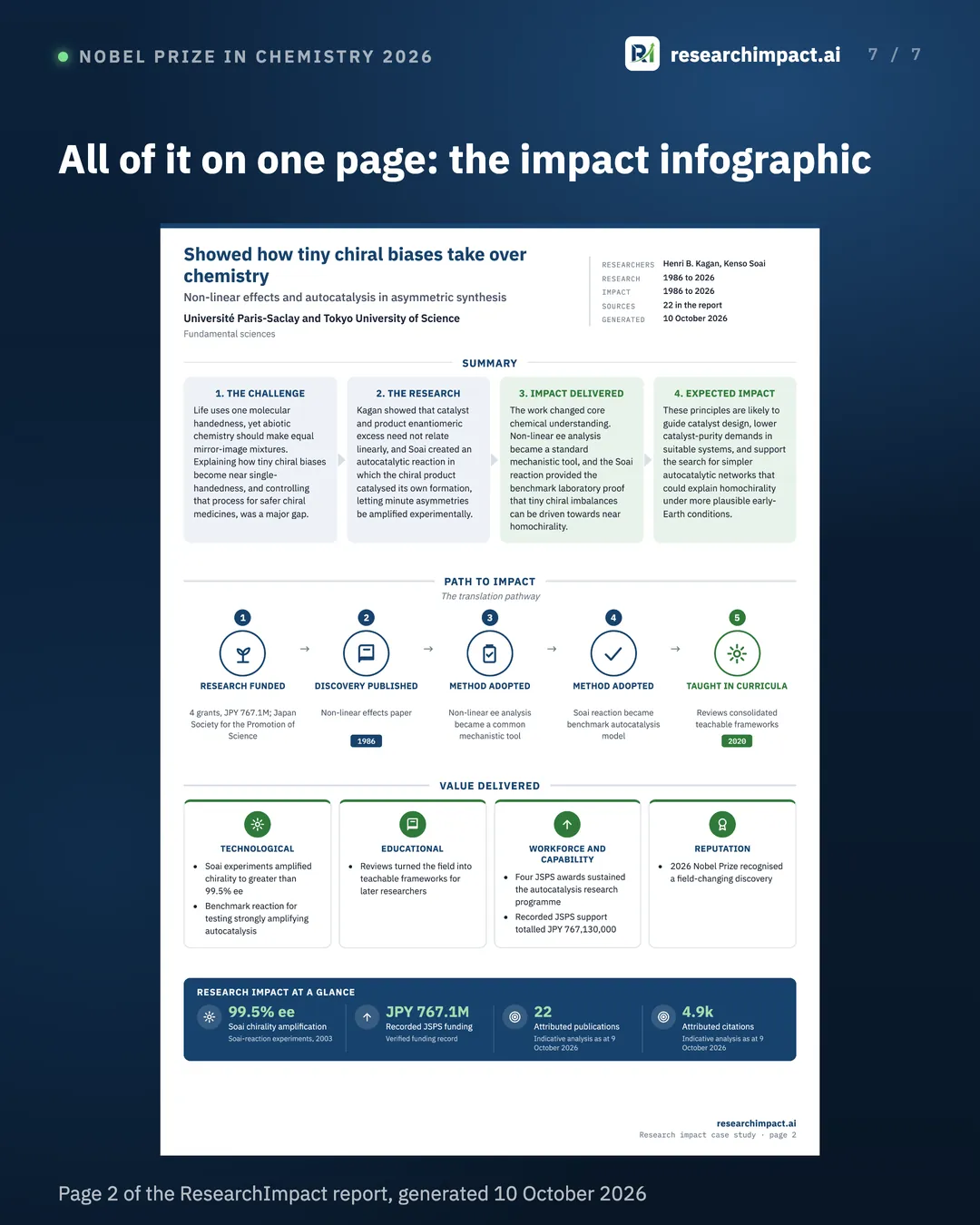
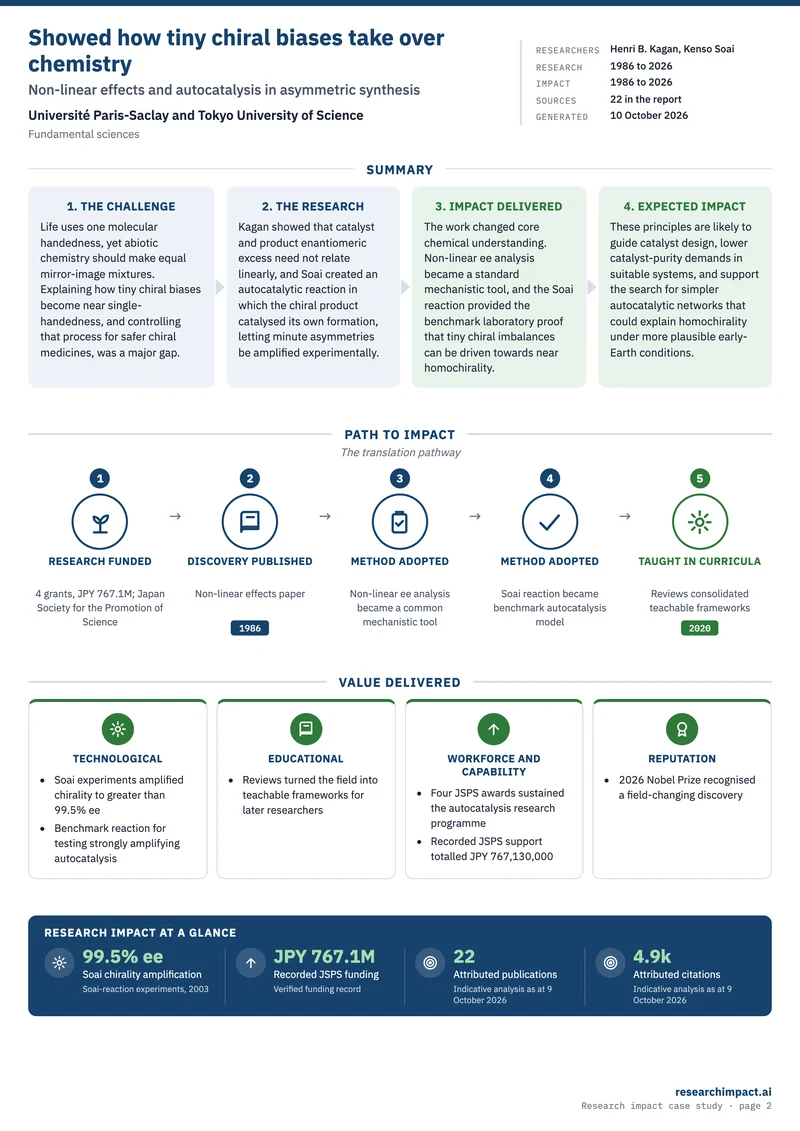
- All of it on one page: the impact infographic The full ResearchImpact infographic for this prize on one page: summary, path to impact, value delivered and research impact at a glance.
The research: left and right in chemistry
Hold up your hands. They are mirror images: alike in every way, yet one will not fit exactly on top of the other. Many molecules exist in the same two forms: a left-handed version and a right-handed version.
Life is strangely one-sided about this. It builds its proteins from one form of amino acid and its sugars from one form only. Chemistry without life makes both forms in equal amounts. How the living world came to use just one hand was a long-standing mystery.
It matters for medicine, too. In many drugs, one form does the beneficial work while its mirror image does nothing, or causes harm. Chemists need reliable ways to produce only the form they want.
Henri Kagan (1986)
Chemists make one-handed molecules with the help of one-handed catalysts. The working assumption was simple: a half-pure catalyst should yield a half-pure product. Kagan proved that this is not always true. In some reactions, the product came out purer than the catalyst that made it.
The explanation lies in how catalyst molecules pair up, because pairs of the same hand and mixed pairs behave differently. His "non-linear" plots became a standard way for chemists to find out what their catalyst is really doing.
Kenso Soai (1995)
Soai discovered a reaction in which the product acts as its own catalyst. Each new molecule helps make more molecules like itself, with the same handedness. Start with a tiny excess of one hand, and it snowballs. In a 2003 experiment, an excess of about 0.00005 per cent grew to more than 99.5 per cent in three rounds. Over those rounds, the leading form multiplied about 630,000 times; its mirror image, fewer than 1,000 times.
In 1953, the physicist F. C. Frank had suggested that a self-copying molecule could tip an even mixture towards one hand. For more than forty years, nobody had a laboratory reaction that did it. Soai's was the first.
What it means
Does this explain why life is one-handed? Not on its own. The Soai reaction is not one that could plausibly have run on the early Earth, and the search for a simpler, prebiotic version continues. What it proves, however, is that chemistry alone can turn a tiny imbalance into near-total dominance.
The work changed everyday practice as well. Non-linear analysis is now a standard tool in asymmetric catalysis, and the Soai reaction remains the benchmark experiment for chirality amplification.
The Nobel Prize in Chemistry 2026 was awarded to Henri B. Kagan of Université Paris-Sud, now part of Université Paris-Saclay, and Kenso Soai of Tokyo University of Science, "for the discovery of non-linear effects and autocatalysis in asymmetric organic synthesis".
Free to reuse
CC BY 4.0The illustrations, slides, film and infographic are CC BY 4.0. Use and adapt them anywhere; credit ResearchImpact and link to this page.
- Credit line
Illustration: ResearchImpact (researchimpact.ai), CC BY 4.0- Suggested citation
ResearchImpact (2026). One hand takes over: Nobel Prize in Chemistry 2026. researchimpact.ai, 12 October 2026. https://researchimpact.ai/explained/2026-nobel-chemistry-mirror-molecules. Licensed under CC BY 4.0.
Sources
- The Royal Swedish Academy of Sciences. Press release: the Nobel Prize in Chemistry 2026. 7 October 2026.
- The Royal Swedish Academy of Sciences. Popular information: the Nobel Prize in Chemistry 2026.
- Université Paris-Saclay. The 2026 Nobel Prize in Chemistry awarded to Henri Kagan, Professor Emeritus at Université Paris-Saclay. October 2026.
- Soai laboratory, Tokyo University of Science. Asymmetric autocatalysis: recent research.
- Puchot C, Samuel O, Duñach E, Zhao S, Agami C, Kagan HB. Nonlinear effects in asymmetric synthesis. Examples in asymmetric oxidations and aldolization reactions. Journal of the American Chemical Society, 1986.
- Soai K, Shibata T, Morioka H, Choji K. Asymmetric autocatalysis and amplification of enantiomeric excess of a chiral molecule. Nature, 1995.
- Sato I, Urabe H, Ishiguro S, Shibata T, Soai K. Amplification of chirality from extremely low to greater than 99.5% ee by asymmetric autocatalysis. Angewandte Chemie International Edition, 2003.
- Frank FC. On spontaneous asymmetric synthesis. Biochimica et Biophysica Acta, 1953.
- Satyanarayana T, Abraham S, Kagan HB. Nonlinear effects in asymmetric catalysis. Angewandte Chemie International Edition, 2009.
- Blackmond DG. Autocatalytic models for the origin of biological homochirality. Chemical Reviews, 2020.
Method
This page starts from a report that ResearchImpact's AI generated on the work of Henri B. Kagan and Kenso Soai from public sources: publication databases, funder records and the web. The infographic is page 2 of that report. We drew the illustrations from it and checked the facts against the sources above.
The two circles in the amplification scene are to scale, in an area ratio of 630 to 1. Kagan's curve, the self-copying cascade and the molecule (a generic one, not the Soai compound) are illustrations.
This is an independent explainer by ResearchImpact. It is not affiliated with or endorsed by the Nobel Foundation, the Royal Swedish Academy of Sciences, the Nobel Assembly at Karolinska Institutet, or the laureates and their institutions.
Questions or feedback? Write to us at info@researchimpact.ai.