Why We Will Not Automate Self-Censorship in Research
ResearchImpact AI will help researchers meet published funder requirements. We will not build a tool that guesses at hidden US government filters or weakens the accuracy of the research record.
If you're applying for US federal funding right now, you're writing under a new kind of uncertainty: an accurate scientific term may also attract political scrutiny.
US federal agencies have used keyword and semantic screening to identify research grants for termination. Researchers are left to decide whether changing a word might protect their funding, their staff and years of work.
It's easy to see why they want help. A banned-words checker could highlight risky terms, suggest euphemisms and return a score implying that a document is safer to submit.
Paste in a grant proposal or impact report. Highlight the terms that might attract scrutiny. Suggest safer synonyms. Return a score that implies the document is now less likely to be rejected.
It would sell.
We will not build one.
Not because the pressure on researchers is trivial. A hidden filter swaps a published requirement for something unstated, then leaves researchers guessing what it might punish. Automating that pressure would turn self-censorship into a product feature while offering confidence that no word checker can justify.
We already help researchers reshape evidence for different funding schemes. We adapt an impact narrative to a funder's published structure, assessment criteria and word limits. That is legitimate grant support: the requirements are visible, the underlying claims remain traceable, and the researcher reviews the result.
What the court record now shows
In July 2026, US federal agencies entered factual stipulations in Thakur v. Trump, a case brought by University of California researchers over terminated grants. For the grants at issue, the National Science Foundation, National Endowment for the Humanities, Department of Defense, Department of Transportation and NIH-HHS stipulated that they selected grants for termination because the grants:
"expressed, or were presumed to express, viewpoints disfavored by the Administration."
That is the central problem. The screening did not merely check whether applicants had followed a clearly published call. It used search terms and other general criteria to identify grants presumed to hold a disfavoured viewpoint. The same filing states that the terminations were not based on grant-specific assessment of compliance or performance.
The litigation is continuing. Those admissions were made for the purposes of this case, and the court has not yet issued a final judgment on the constitutional claims. But the use of lexical and semantic screening for the grants at issue is no longer speculation.
Nor is there one single, official US government list. PEN America's aggregation combines more than 350 terms reported across different US agencies and contexts, including website edits, internal advice, extra review and grant screening. A community-maintained checker collects roughly 1,000. These are useful records of uncertainty, not official lists of words that will always trigger the same action.
That distinction matters. When the actual criteria are partly hidden, overlapping and inconsistent, rational people do not wait for certainty. They over-comply.
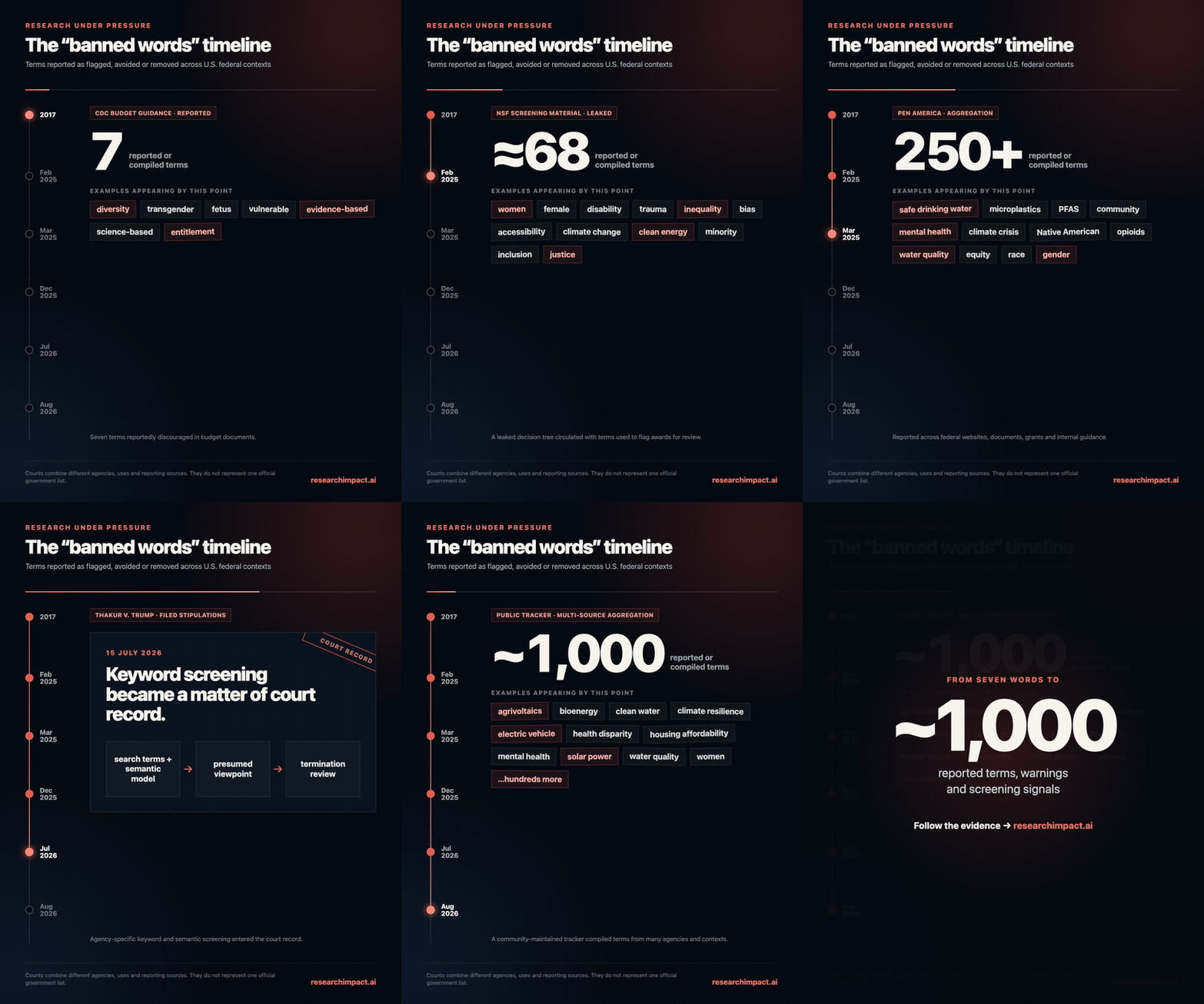
Counts combine different agencies, uses and reporting sources. They do not represent one official government list.
The language has already changed
A 2025 BMJ observational study examined 17,701 abstracts of NIH grant awards. Between October and November 2024, the rate of diversity-related language fell from 11.11 to 5.42 words per 1,000, a relative decline of 51 per cent.
The stronger comparison was within the same research. Among 1,967 pairs of grants renewed non-competitively in 2025, the targeted vocabulary made up less than 1 per cent of all words but about 10 per cent of deleted words. Those terms were removed at roughly ten times the rate of other words.
The study cannot tell us what every grant writer intended. It covers abstracts of awarded grants, not every submitted application, and some language changes may reflect changing research priorities. Its findings are nevertheless strong observational evidence of a measurable shift in how the same work was described.
This is what uncertainty does. Researchers start editing against the possibility of a filter before they know exactly what it contains.
Write to the call, not a hidden list
Funders are entitled to set priorities. Researchers have always framed proposals around a call, and elections and appropriations inevitably influence what public agencies support. Terminology can also change without changing the science.
But real priorities should be stated openly and judged on their merits. If a funding body no longer supports a field of work, it should say so and defend that decision. A word search should not stand in for that judgement.
A keyword filter is not peer review. It cannot determine whether a reference to "inequality" concerns a social outcome or a mathematical expression. It cannot distinguish "cellular diversity" from a workforce policy. A synonym may dodge a literal word match while the subject, institution or funding mechanism stays visible to other kinds of screening. A "safe to submit" score would therefore promise something no word checker can know.
We should also be honest about the pressure on researchers. A principal investigator protecting staff salaries, participant relationships, animals, longitudinal data and years of work may decide that changing a phrase is the least damaging option. That is not a choice we will moralise from the sidelines. Researchers should not have to choose between accurate language and keeping a lab open.
Our responsibility is narrower: decide what our software will normalise.
We will help a researcher express verified evidence in the form a published funding call requests. We will not build a political blacklist, delete accurate terms, or disguise the subject of the research. The judgement stays with the researcher.
An impact report is an evidence record
The line becomes even clearer in impact reporting.
A proposal is an argument for future funding. An impact report records what was studied, who was affected and what changed. If software makes those descriptions less specific, it removes information from the record itself.
Suppose research measured maternal mortality among Black women. Replacing that population with "certain groups" does not simply soften the tone. It makes the work harder to find, compare and evaluate. It weakens the link between the evidence, the people represented in it and the policy decisions that may follow.
When a proposal is euphemised, it loses precision. When an impact report is euphemised, the evidence record loses information.
ResearchImpact AI is built around the opposite principle. We search for documented impact, trace claims to their sources, surface the evidence for human verification and tell users to review every output. A feature that silently weakened accurate descriptions would conflict with the reason the platform exists.
What we will and will not do
We will explain current, published requirements from the relevant call, policy or award terms. We may point researchers to documented, dated word lists so they can assess the evidence themselves. Where the risk is real, the right next step is a research office or qualified legal advice, not a software-generated assurance.
We will not:
- build an in-product blacklist;
- automatically delete, replace or disguise flagged terms;
- produce a "safe to submit" score;
- use semantic classification to conceal a politically disfavoured subject;
- silently weaken descriptions of participants, beneficiaries or outcomes; or
- use customer text to expand a blacklist.
These are product commitments, not instructions to individual researchers. People facing a funding decision will make their own judgements, with consequences we don't have to live with. We will not build a product that automates those judgement calls.
A banned-words checker would be straightforward to ship. That does not make it responsible.
We will explain published requirements. We will preserve traceable evidence. And we will never let software silently change what the evidence says.