Write your impact once, then reshape it for any funder
A new grant proposal costs an Australian researcher around 34 working days. A lead investigator can sink 116 hours into one application. When researchers tracked a single year of submissions to Australia's main health-research funder, the total reached 550 working years and roughly AU$66 million in salaries. Four in five were rejected.
Look at where the time actually goes and a pattern appears. The science barely changes between applications. The packaging changes constantly.
Your impact narrative is the part you rewrite most often, and the part funders increasingly weigh most heavily. Every scheme asks for it differently, and so does every section within one application. An ARC submission alone wants the national interest in 200 words of plain English with no citations, then the same significance argued again at length across the project description and your track record. Apply to a different scheme next round, or resubmit the following year, and the framing shifts once more. For anyone reaching across borders the gap is wider still: a UK REF case study runs to 2,200 words built on corroborating evidence, while an NSF summary is split across three boxes with their own logic. Same underlying work, rebuilt from a blank page each time. That is the friction we set out to remove.
What Smart Grant Adaptation does
Run ResearchImpact AI on your publications once and you get a structured assessment of your work: its significance, its outputs, the difference it has made, and where it is heading. That report becomes a source you can draw on again and again.
Pick a funding scheme, and the platform redrafts the impact-relevant sections of your application to fit it. The wording follows the scheme's structure, respects its word and character limits, and answers what its assessors are told to look for. You get back an editable document, section by section.
A note on what this is and is not. It drafts the sections where your research impact carries the argument. It does not write your methodology, your budget, or your team's track record, and it is not a finished submission. Treat the output as a strong first draft that you read, check against the current guidelines, and make your own. The judgement stays with you.
We are starting with more than thirty of the most widely used schemes across Australia, the UK, Europe, the US and Canada, and adding more over time.
How it works
Three steps, all from your dashboard.
- Generate your impact report from your publications.
- Browse the grant scheme guide and find a fit by country, career stage and type.
- Open the report, choose the scheme, and download the adapted sections.
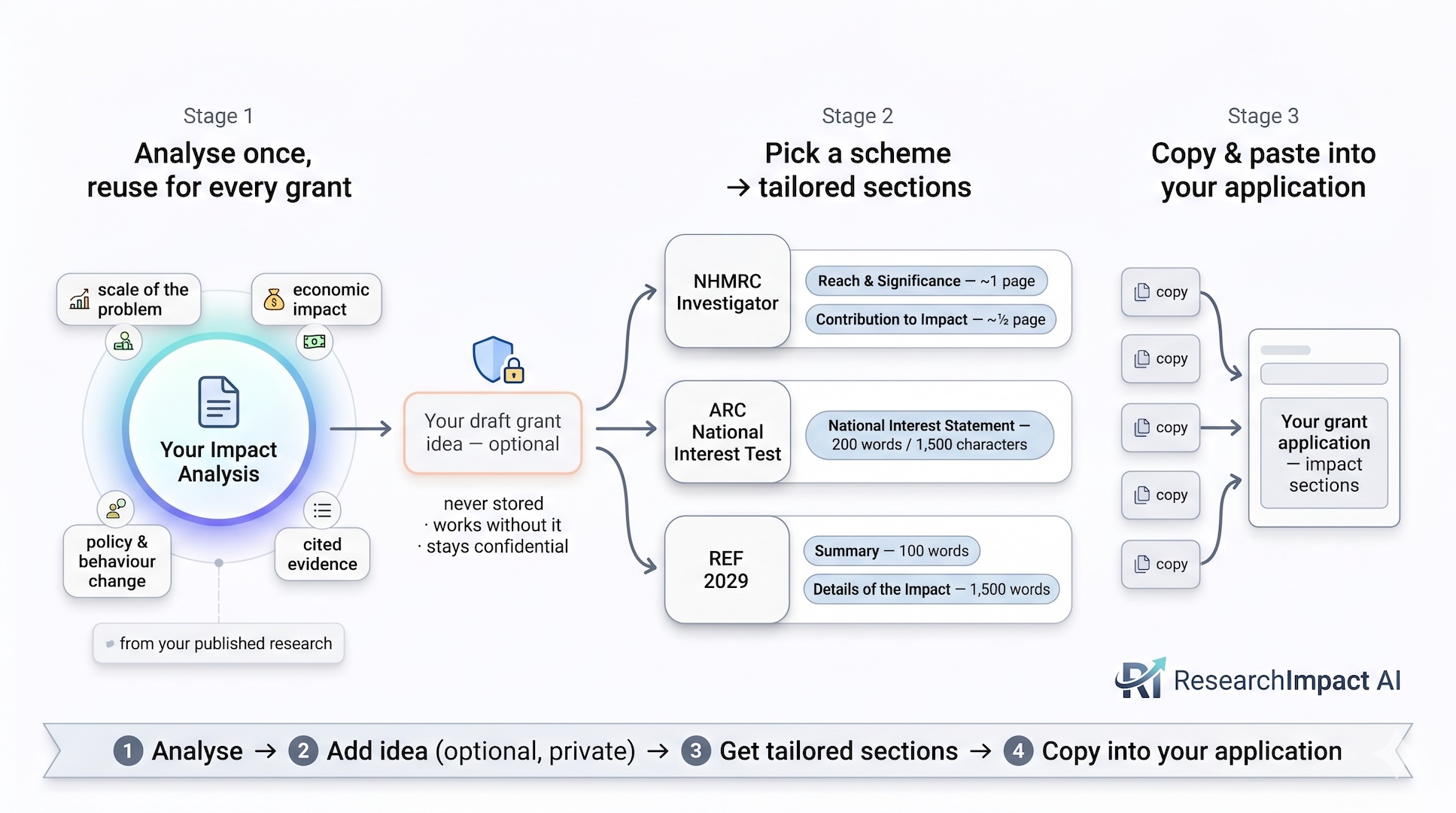
Two-stage schemes are handled properly, so an ARC Discovery expression of interest and its full application come out as separate, correctly shaped drafts. You can add a short steer if you want a particular angle led, for instance a health-economic framing over a purely clinical one.
Why this is not a generic chatbot rewrite
The difference sits in the constraints. Each scheme has a template behind it that encodes the real section codes, the exact limits, and the assessment weighting. If a draft section runs over its character limit, the system notices and tightens it rather than handing you something that will not paste into the portal.
References matter too. Citations are drawn from the evidence in your own report, validated, and hyperlinked. Anything the system cannot trace to a real source is flagged rather than quietly invented. You are reshaping verified evidence, not generating fresh claims that you then have to fact-check.
The deeper difference is in what the report knows that you might not. A chatbot can only rework the words you feed it. The base analysis goes further and investigates the problem your work addresses: how large it is, what it costs, who it affects, and where your contribution sits in the wider field. Researchers are often closest to the method and furthest from that picture. You know your technique works; you may never have quantified the burden it could lift, or the scale of the population it could reach. Funders ask precisely that, and reward the applicants who can answer it. The adaptation carries that grounding into each section, so the significance of your work is stated at the scale assessors are looking for.
For research offices and grant teams
The same blind spot shows up from the other direction, and grant advisers will recognise it at once. Researchers undersell not only the scale of the problem, but what their work has already changed. Ask them about it and you hear about papers, citations and conference talks. The policy that shifted, the clinical guideline that changed, the tool a company now uses, the dataset others build on: these often go unmentioned, because researchers do not always see them as part of the story.
That gap is exactly what an experienced research office spends its time drawing out, and it is what funders increasingly reward. Smart Grant Adaptation surfaces that broader impact from the analysis and places it where each scheme asks for it. For a busy grants team, that means starting from a draft that already speaks the funder's language, with the wider significance made visible, rather than coaxing it out of a publication list one researcher at a time. One analysis can support many applications across a faculty, with a consistent evidence base underneath each.
The timing helps, too. Success rates are tight; NIH early-career rates fell below 19% in 2025. The sensible response is to apply more widely and target carefully, and that only works if reshaping your impact narrative for the next scheme takes minutes rather than another fortnight.
Your pre-submission text stays yours
If you paste in proposal text to steer the draft, that text is sensitive, and we treat it that way. It is sent to the AI model provider only to produce your document. It is not stored: no database record, no logs, no audit copy. The model provider's API terms exclude using your input to train their models. The only thing we keep is the generated document, which is yours to download.
If your institution restricts sharing unsubmitted text at all, you can run the adaptation without it. The draft then rests entirely on the research impact analysis already in your report.
Try it on your next application
If you already have a report, open it in your dashboard and choose a scheme. If you are new, you can start free and browse the scheme guide to see what fits your work.
You wrote the research. You should only have to tell its impact story once.